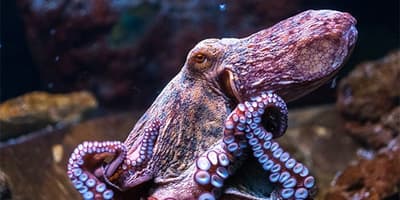
An octopus is a soft-bodied mollusk with eight limbs. They are classified under the order Octopoda. There are about 300 species grouped within the class Cephalopoda this also includes cuttlefish and squid. Octopuses are quite fascinating creatures, but did you know some of the male species have a peculiar way of copulating with the females?
Translate: "An octopus is a soft-bodied mollusk with eight limbs." => "タコは8本の腕を持つ柔らかい体の軟体動物です。" "They are classified under the order " => "それらは目次(order)" but better: "それらは目(order)" Actually "order" is "目". So: "それらは目である" maybe: "それらは目(Octopoda)に分類されます。" We'll keep the order name. "There are about 300 species grouped within the class " => "約300種がクラス(Cephalopoda)に属しています。" "this also includes cuttlefish and squid." => "これにはイカやコウモリダコも含まれます。" Actually cuttlefish is "コウモリダコ" or "イボダコ". Use "コウモリダコ". "Octopuses are quite fascinating creatures, but did you know some of the male species have a peculiar way of copulating with the females?" => "タコは非常に興味深い生物ですが、オスの種の中には雌と交尾する際に特異な方法を持つものがあることをご存知ですか?" Need to keep the inline tags: Octopoda and similar. Second paragraph:Some male octopuses build dens next to female octopus dens. They copulate by stretching the mating arm from one den to the other.
Translate: "Some male octopuses build dens next to female octopus dens. They copulate by stretching the mating arm from one den to the other." => "一部のオスのタコはメスのタコの巣の隣に巣を作ります。彼らは交尾腕を伸ばして、一方の巣からもう一方の巣へと交尾します。" Third:What are Cephalopods?
Translate heading: "Cephalopodsとは何ですか?" Use "頭足類とは何ですか?" Cephalopods Japanese term "頭足類". So:頭足類とは何ですか?
Next paragraph:Cephalopods are any member of the phylum Mollusca’s class Cephalopoda. They are a small group ...
Translate: "Cephalopods are any member of the phylum Mollusca's class Cephalopoda." => "頭足類は、門Mollusca(軟体動物門)のクラスCephalopoda(頭足綱)に属するすべての生物です。" Keep tags. Continue: "They are a small group of highly evolved and organized, exclusively marine organisms. Representatives include the octopus, squid, cuttlefish, and chambered Nautilus. Extinct forms outweigh extant forms, with the class achieving tremendous diversity in the late Paleozoic and Mesozoic periods." Translate: "それらは高度に進化し、組織化された小さな海洋専用の生物群です。代表例としてタコ、イカ、コウモリダコ、そして房室ナウチルスが挙げられます。絶滅形態は現存形態を上回っており、このクラスは後期古生代と中生代において驚異的な多様性を達成しました。" Need to keep tags around Mollusca and Cephalopoda. Next paragraph:Except for five surviving species of nautilus, ammonites, belemnites, nautiloids are extinct. (Source: Britannica)
Translate: "ナウチルスの5種の生存種を除き、アンモナイト、ベレミン、ナウチロイドは絶滅しています。(出典: Britannica)" But need to keep anchor unchanged. Next heading:What is an Octopus?
Translate: "タコとは何ですか?" Next paragraph:Octopuses have spherical bodies, bulging eyes, and eight lengthy arms and are chevaliers of the water. They can be found in all of the world’s oceans but thrive in warm, tropical environments.
Translate: "タコは球形の体と突出した目、そして8本の長い腕を持ち、水中の騎士と言える存在です。世界中のすべての海に生息していますが、温かく熱帯の環境で特に繁栄します。" Next paragraph:Octopuses, like their cousin the squid, are commonly referred to as deep-sea monsters, although some species, or kinds, live in very shallow seas. (Source: National Geographic Kids)
Translate: "タコはイカという近縁種と同様に、一般的に深海の怪物と呼ばれますが、いくつかの種は非常に浅い海に生息しています。(出典: National Geographic Kids)" Next heading:How Do Octopuses Reproduce?
Translate: "タコはどのように繁殖しますか?" Next paragraph:Octopuses are solitary creatures by nature. When they do come into contact, it’s usually over mates, opportunistic copulation, and cannibalism.
Translate: "タコは本質的に単独生活の生物です。接触する場合は、主に交尾、機会的な交尾、そしてカニバリズムが原因です。" Next paragraph:On their suckers, octopuses have thousands of chemoreceptors that they can utilize to touch and taste each other before copulating. When you consider how many octopuses are cannibalistic, this sounds lovely.
Translate: "タコの吸盤には何千もの化学受容体があり、交尾前に互いに触れ味わうことができます。タコがどれほどカニバリズム的かを考えると、これはとてもロマンチックに聞こえます。" Next paragraph:Some octopus species have dens on the seafloor, where males and females live side by side. This enables them to copulate with their neighbors over and over again. Some of these octopuses can mate without ever leaving their den. Males establish dens near females and give sperm packets to them with their lengthy mating arms. This could protect men from being attacked or devoured.
Translate: "一部のタコ種は海底に巣を作り、オスとメスが隣り合わせに暮らしています。これにより、近くの仲間と何度も交尾することが可能です。これらのタコの中には、巣を離れることなく交尾できるものもいます。オスはメスの近くに巣を作り、長い交尾腕で精子パックを渡します。これにより、オスが攻撃されたり食べられたりするリスクが減少します。" Make sure to preserve tags: all, , , , , , An octopus is a soft-bodied mollusk with eight limbs. They are classified under the order Octopoda. There are about 300 species grouped within the class Cephalopoda this also includes cuttlefish and squid. Octopuses are quite fascinating creatures, but did you know some of the male species have a peculiar way of copulating with the females? Some male octopuses build dens next to female octopus dens. They copulate by stretching the mating arm from one den to the other. Cephalopods are any member of the phylum Mollusca’s class Cephalopoda. They are a small group of highly evolved and organized, exclusively marine organisms. Representatives include the octopus, squid, cuttlefish, and chambered Nautilus. Extinct forms outweigh extant forms, with the class achieving tremendous diversity in the late Paleozoic and Mesozoic periods. Except for five surviving species of nautilus, ... Octopuses have spherical bodies... Octopuses, like their cousin the squid... Octopuses are solitary creatures by nature... On their suckers... Some octopus species have dens... 少なくとも3種のタコで、メスは交尾を開始するためにオスに近づきます。メスのタコは、岩の上や腕で抱えている糸状のものに卵を産んだ後、卵を守り、清掃します。深海タコの中で、4年以上も卵を守っている個体が確認されており、これは動物の中で最も長い期間です。(出典:Monterey Bay Aquarium Research Institute) タコには3つの心臓があります。World Animal Foundationによると、1つは臓器に血液を送り、もう1つはエラに血液を送ります。タコの血液は銅を含むタンパク質であるヘモシアニンを含んでいるため青色です。 タコの臓器に血液を供給する器官は、泳いでいる間に拍動を止めます。スミソニアンの記事によると、これがタコを疲労させる原因であり、タコが泳ぐよりも這うことを好む理由です。(出典:Live Science), . Also preserve style attributes.
Now produce final HTML with translations.
Check first paragraph: need to keep around each segment. The original had three spans: before order, after order, after class. We'll keep same structure.
Original first paragraph:
What are Cephalopods?
=> 頭足類とは何ですか?
Paragraph with tags:
Original: What is an Octopus?
=> タコとは何ですか?
Paragraph: How Do Octopuses Reproduce?
=> タコはどのように繁殖しますか?
Paragraph: タコは何個の心臓を持っていますか?