
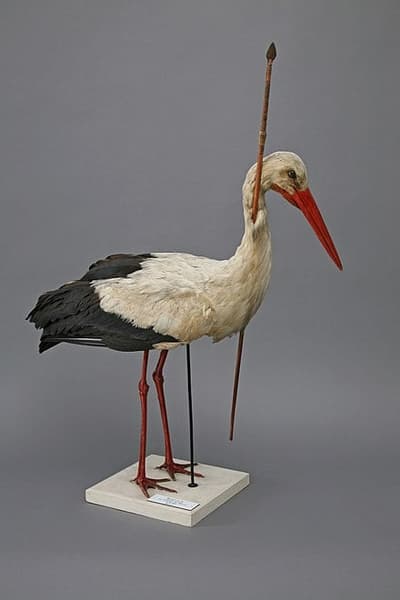
Pfeilstorch
Мигрирующий аист, поражённый стрелой
The Rostocker Pfeilstorch, found in 1822, demonstrated that birds migrated rather than hibernating or changing form in winter. Ростокский Pfeilstorch, найденный в 1822 году, продемонстрировал, что птицы мигрируют, а не впадают в спячку или меняют форму зимой. The term Pfeilstorch (German for ‘arrow stork’, pronounced [ˈpfaɪ̯l.ˌʃtɔɐ̯ç]; plural Pfeilstörche, [-ˌʃtœɐ̯.çə]) is given to storks injured by an arrow while wintering in Africa, before returning to Europe with the arrow stuck in their bodies. As of 2003, around 25 Pfeilstörche have been documented in Germany. Термин Pfeilstorch (немецкое слово, означающее ‘стрелочный аист’, произносится [ˈpfaɪ̯l.ˌʃtɔɐ̯ç]; множественное число Pfeilstörche, [-ˌʃtœɐ̯.çə]) применяется к аистам, получившим травму от стрелы во время зимовки в Африке, а затем вернувшимся в Европу со стрелой, застрявшей в их теле. По состоянию на 2003 год в Германии было зафиксировано около 25 Pfeilstörche. The first and most famous Pfeilstorch was a white stork found in 1822 near the German village of Klütz, in the state of Mecklenburg-Vorpommern. It was carrying a 75-centimetre (30 in) spear from central Africa in its neck. The specimen was stuffed and … Продолжить чтение (2‑минутное чтение)