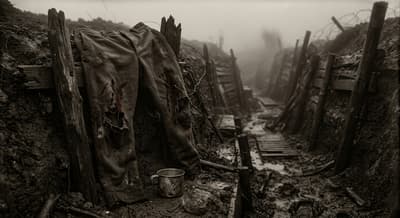
On February 11, 1915, a 33-year-old farrier named Lucien Bersot stood shivering in the trenches of the Aisne, wearing the thin white canvas trousers he'd been issued at induction. Every soldier around him wore the standard-issue red wool pants, the famous pantalon rouge that had defined the French infantry for nearly a century. Bersot just wanted a pair that fit. What he got instead was a death sentence.
When Bersot asked his quartermaster sergeant for wool trousers, the sergeant offered the only pair available: tattered, bloodstained, stripped from the body of a dead comrade.[1] Bersot refused. For this, he was initially sentenced to eight days in prison by his lieutenant. A reasonable, if harsh, punishment. But the new regimental commander had other plans.
Lieutenant-Colonel François Maurice Auroux had taken command of the 60th Infantry Regiment just three weeks earlier, on January 22. A veteran of France's colonial campaigns in Africa, he'd been brought in specifically to toughen up a unit that the general staff considered underperforming after heavy losses near Soissons.[1] Fresh recruits had just arrived. Auroux wanted to make sure they understood the rules. Bersot became his teaching tool.
Auroux convened a special court-martial. He acted as both the accuser and the presiding judge, a violation of Article 24 of the French Code of Military Justice.[1] The charge was disobedience in the face of the enemy, even though the refusal had taken place behind the lines, nowhere near combat. Two of Bersot's comrades, Elie Cottet-Dumoulin and Mohn André, stepped forward to plead for mercy. Auroux punished them too: forced labor in North Africa.[2] Cottet-Dumoulin would die in Serbia in 1917, never returning home.
The verdict was death. Some members of the firing squad refused to shoot their comrade.[1] On February 13, 1915, two days after he'd asked for a pair of warm pants, Lucien Bersot was executed at Fontenoy. He left behind a wife and a five-year-old daughter.
The trousers Bersot was killed over were already obsolete. The bright red pantalon rouge had been a source of French military pride since 1829, originally adopted to support the domestic rose madder dye industry.[3] But by 1914, every other major army in Europe had switched to drab, camouflaged uniforms. The French had not. The result: soldiers marched into battle wearing pants so bright they made perfect targets. By December 1914, two months before Bersot's execution, the army had already begun replacing the red trousers with a new horizon-blue uniform.[3] The very garment Bersot died for refusing to wear was a garment the army itself had decided was getting soldiers killed.
After the war, a young lawyer named René Rücklin took up Bersot's case, backed by the newspaper Germinal and the League of Human Rights. On July 12, 1922, the Cour de Cassation formally rehabilitated him, confirming what everyone already knew: the trial had been illegal from start to finish.[2] Bersot was one of roughly 700 French soldiers shot as an example during WWI. His widow finally received her war widow's pension. His daughter was recognized as a ward of the nation.
André Maginot, the Minister of War (yes, that Maginot, of the famous defensive line), blocked prosecution of Auroux, dismissing it as an "anti-militarist campaign."[1] Auroux retired in 1924, unpromoted but unpunished.
Lucien Bersot didn't refuse to fight. He didn't desert. He didn't mutiny. He refused to pull on a pair of pants still wet with another man's blood. For that, he was shot at dawn while some of his own squad members lowered their rifles. Over a century later, his story still forces a question that has no comfortable answer: when obedience requires you to wear a dead man's clothes, who is the real coward, the soldier who says no, or the commander who kills him for it?