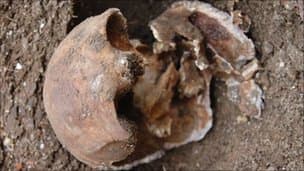
Imagine a quiet afternoon in a lush, green garden—the kind of peaceful sanctuary that has served as the backdrop for the life's work of Sir David Attenborough. But as a shovel strikes the earth, the sound isn't the dull thud of a root or the clink of a stone. It is something harder. Something smooth. Something undeniably human.
A skull. It sits in the dirt, a silent witness to a story buried for over a century. For decades, this object was nothing more than a fragment of a puzzle everyone assumed was lost to time. But the earth doesn't just hold secrets; it holds grudges. And the secret buried in this particular garden was one of the most gruesome unsolved mysteries of the Victorian era.
The Ghost of 1879
To understand the skull, we must return to 1879, to the London suburb of Barnes. At the time, the area was a bastion of Victorian propriety, but beneath its respectable veneer, a nightmare was unfolding. The victim was Julia Martha Thomas, a woman in her 50s living a life of modest comfort. She was not a figure of grand importance, but her death would become a sensation that gripped the nation.
The perpetrator was no stranger lurking in the shadows; it was someone invited into the home, someone who knew exactly where the silver was kept. It was her maid, Kate Webster[1]. What followed was a calculated, chilling attempt to erase a human being from existence. Webster didn't just kill Mrs. Thomas; she dismembered her in an attempt to dispose of the evidence with an audacity that remains one of the most stomach-turning details in criminal history: she even attempted to sell parts of the remains to unsuspecting neighbors, passing them off as meat[2].
When the police finally closed in on Webster, they found a trail of carnage and discarded remains. But there was one glaring, impossible omission: the head was gone. Despite exhaustive searches across London, the skull of Julia Martha Thomas could not be found. The case became known as the "Barnes Mystery"—a crime solved, but a victim left partially unrecovered.
The Missing Piece of the Puzzle
For over 140 years, the Barnes Mystery lived in the archives. The killer had been executed and the crime cataloged, but the physical reality of the victim remained incomplete. The missing head became a sort of forensic ghost story—a hollow void in the historical record. It was as if the earth had swallowed the most vital part of the story, leaving 19th-century investigators with a permanent, unanswered question.
Then, the discovery in the garden of Sir David Attenborough bridged the gap between the Victorian underworld and the modern world. It wasn't just a random find; it was a collision of eras. When the skull was recovered, it acted as a biological time capsule. The question wasn't just what it was, but whose it was. How did a piece of a 19th-century murder victim end up in the backyard of one of the world's most famous naturalists?
Where Science Meets History
Solving a century-old mystery requires a marriage of disciplines: the meticulous archival work of a historian and the microscopic precision of a forensic scientist. This is where the Barnes Mystery finally met its end.
Forensic experts, including Alison Thompson, began the painstaking process of analyzing the remains[3]. They weren't just examining bone; they were reading a biography. By studying the skull's structure, dental wear, and specific markers of age and sex, they compared biological clues against the historical records of the Thomas family and the gruesome details recorded in the 1879 police files.
The evidence was overwhelming. Every anatomical detail pointed to a single conclusion: the skull belonged to Julia Martha Thomas[3]. The woman Kate Webster had attempted to erase had finally been found. It was a moment where 21st-century technology reached back through time to provide the closure that 19th-century detectives could only dream of.
As Chief Superintendent Clive Chalk noted, this wasn't just a win for forensics; it was a triumph of integrated detective work[4]. It was the moment where historical records, investigative rigor, and modern science converged to finish a story left hanging for over a century. The Barnes Mystery wasn't just solved; it was finally, completely, laid to rest.
Sources
- Historical records of the Kate Webster murder trial, 1879.
- The "Barnes Mystery" archival reports, London Metropolitan Police.
- Forensic analysis reports by Alison Thompson regarding the Thomas skull recovery.
- Statements from Chief Superintendent Clive Chalk regarding the case resolution.