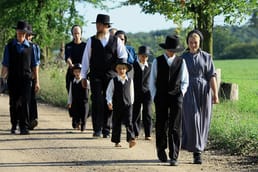
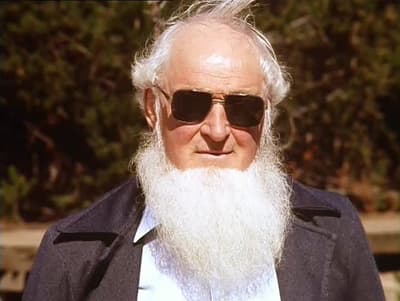
On the morning of his wedding, a young Amish man may still have a clean-shaven face. A week later, the outline begins to show along his jaw and chin. The beard is not a fashion experiment or a grooming phase. In many Amish communities, it is the visible sign that a boy has crossed into married adult life.[1]
Amish men traditionally grow beards without mustaches because the beard reflects faith, maturity, and community identity, while the mustache became associated with soldiers and military culture. For a people committed to nonresistance, the upper lip stays shaved.
Look closely at the face and the rule becomes more precise than it first appears. The beard may be long and full, spreading from the chin and jaw, but the strip above the lip is deliberately kept bare.[1] That small shaved space carries a history larger than grooming.
In Amish communities, hair sits alongside clothing, transportation, church practice, and plain speech as a public sign of separation from mainstream society. Amish Heritage describes the beard as part of a tradition tied to humility, cultural identity, and obedience to a shared religious order.[1] It is personal hair, but not merely personal style.
Leviticus 19:27 is often brought into the discussion: "Do not cut the hair at the sides of your head or clip off the edges of your beard."[1] The biblical world matters, too. Military.com notes that the men in the settings of biblical stories lived in a time when beards were common, and Amish men have treated the beard as a visible homage to that older religious model.[3]
The Missing Mustache
Across the upper lip, the meaning changes. In the 1800s, mustaches became closely associated with military men, and British troops were at one point required to wear facial hair above the lip.[3] War History Online says that requirement lasted until World War I, when trench conditions and concerns about gas-mask seals helped bring it to an end in October 1916.[4]
For the Amish, the military association mattered because nonresistance is central to Amish belief. Military.com describes Amish teaching as rejecting military service and participation in war.[3] So the beard could point toward scripture, adulthood, and community, while the mustache pointed toward armies, uniforms, and violence. The result is a style that looks unusual to outsiders but reads plainly inside the tradition: beard yes, mustache no.
That bare upper lip also explains why an "Amish beard" is so recognizable. Other men grow long beards for fashion, religion, habit, or simple dislike of shaving. The Amish version is defined as much by absence as by growth. The missing mustache is part of the message.
In some Amish communities, the beard also works where a wedding ring might work elsewhere. Amish men generally do not wear wedding rings, so a beard can signal that a man is married, though Amish Heritage cautions that the guideline does not apply identically in every Amish group.[1] A single man may remain clean-shaven, while a married man lets the beard come in and keeps shaving the mustache area.
Local practice varies, and one beard cannot explain every Amish settlement.[1] Still, the broad pattern holds: the beard belongs to faith, adulthood, tradition, and separation from the wider world; the mustache carries an inherited military meaning that Amish men avoid.
So the face becomes a quiet statement. No banner, no badge, no speech. Just hair allowed to grow along the jaw, hair removed above the lip, and a refusal of the soldier’s symbol repeated at the mirror.