
You are in the middle of a sentence. The thought is vivid, the concept is clear, and the word is hovering just behind your teeth. You can almost feel its shape; you can even sense its rhythm. But when you reach for it, there is nothing but a hollow, frustrating silence. You know the word. It is right there. Just out of reach.
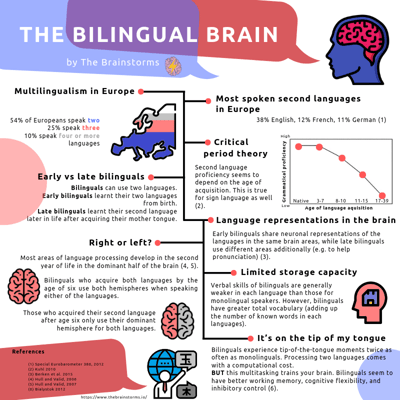
In linguistics, this is known as the "tip-of-the-tongue" state—a momentary glitch in the brain's retrieval system. For a monolingual speaker, it is a minor, occasional annoyance. But for someone who speaks two or more languages, this phenomenon is a statistical regularity. Research suggests that bilinguals experience these moments of lexical frustration nearly twice as often as those who speak only one language[1].
At first glance, this sounds like a deficit. It suggests a brain that is less efficient, more prone to stumbling over its own feet. But if you look closer, the "glitch" isn't a sign of a broken system. It is actually a side effect of a high-performance engine running at maximum capacity.
The War of the Lexicons
To understand why the word disappears, you have to understand the chaos happening behind the scenes. When a monolingual person wants to say "apple," their brain searches a single, streamlined database, finds the entry, and hits "play." It is a direct route.
For a bilingual, the process is far more contested. When you want to say "apple," your brain isn't just searching for that word; it is simultaneously fighting off the word "manzana." Even when you are speaking English, your Spanish vocabulary doesn't simply turn off. It remains active, hovering in the periphery, ready to intrude[2].
This creates a state of constant "lexical competition." Every time a bilingual person speaks, their brain is engaged in a high-stakes tug-of-war. To communicate successfully in one language, the brain must actively suppress the other. This process, known as inhibitory control, is the mental equivalent of trying to listen to a single radio station while three others are playing at low volumes in the background[3]. The "tip-of-the-tongue" moment occurs when the competition becomes too intense—when the brain momentarily fails to suppress the "wrong" language, causing the "right" word to get lost in the crossfire.
The Computational Cost of Multitasking
This competition comes with what neuroscientists call a "computational cost." Because the brain is constantly managing two competing systems, it must expend extra energy on linguistic management rather than mere delivery. This is why bilinguals might occasionally struggle with word retrieval or experience a slight delay in processing speed during complex tasks[4].
It is a heavy cognitive load. You are essentially running two operating systems on the same hardware, and the background processes required to keep them from crashing into one another are immense. But, as is often the case with the human brain, this heavy lifting comes with a profound biological reward.
The Ultimate Brain Gym
If the bilingual brain is constantly fighting a war of suppression, it is effectively engaged in a lifelong, high-intensity interval training session. This constant management of competing languages strengthens the brain's "executive functions"—the command center responsible for attention, task-switching, and filtering out distractions[5].
Because bilinguals are forced to practice inhibitory control every single day, they develop a specialized kind of cognitive resilience. This isn't just a theory; it is visible in the brain's physical structure. Studies have shown that the constant "workout" of managing two languages can lead to increased gray matter density in regions associated with executive control[6].
Perhaps most strikingly, this training provides a massive buffer against aging. While no amount of linguistic practice can prevent neurological decline, the enhanced cognitive reserve built by bilingualism has been shown to delay the onset of dementia and Alzheimer’s symptoms by as much as four to five years[7]. The brain, having spent a lifetime navigating interference and managing complexity, becomes much harder to break.
The Early Advantage
The way this training is integrated into the brain also depends heavily on when the journey begins. There is a distinct neurological difference between those who pick up a second language in adulthood and those who acquire it in childhood.
Bilinguals who acquire both languages by the age of six tend to utilize both hemispheres of the brain more symmetrically when processing either language[8]. In these early learners, the two linguistic systems become so deeply woven into the neural fabric that the brain treats them not as two separate files, but as a single, integrated, and highly efficient network. They aren't just "using" two languages; they are fundamentally re-wiring their architecture to accommodate them.
So, the next time you find yourself grasping for a word, frustrated by that nagging sense of almost, don't view it as a failure. Instead, see it for what it truly is: the sound of a highly sophisticated, incredibly resilient brain working overtime to keep the peace.
Sources
- ScienceDirect: The Tip-of-the-Tongue Phenomenon
- Nature: Lexical Competition in Bilinguals
- NCBI: The Cognitive Benefits of Being Bilingual
- Psychology Today: The Bilingual Brain and Cognitive Load
- Harvard Health: How Bilingualism Protects the Brain
- Frontiers in Human Neuroscience: Structural Plasticity in Bilinguals
- Mayo Clinic: Cognitive Reserve and Aging
- ScienceDaily: Early Language Acquisition and Brain Structure