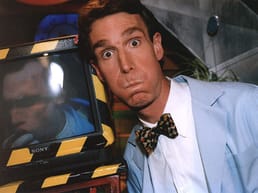

When you think of Bill Nye, you likely picture a man in a lab coat, enthusiastically explaining the laws of thermodynamics to a generation of wide-eyed children. He is the quintessential "Science Guy"—a persona defined by high energy and the infectious joy of discovery. But long before he was a household name on PBS or a Netflix sensation, Nye wasn't just talking about science. He was practicing it in one of the most rigorous, high-stakes environments imaginable: the aerospace industry.
There is a profound difference between explaining how a machine works and being the person responsible for ensuring that machine doesn't fail at 35,000 feet. For Nye, that difference was bridged in the design offices of Boeing in Seattle, where his work wasn't about television ratings, but about the structural integrity of the world's most iconic aircraft.
The Engineering Behind the Icon
Long before the catchy theme song and the signature bow ties, William Sanford Nye was a mechanical engineer[1]. He didn't merely study fluid dynamics and mechanical systems at Cornell University; he applied them to the massive, complex machinery of the Boeing Corporation[1]. At the time, Boeing was refining the 747—the "Queen of the Skies"—an aircraft that revolutionized global travel by making long-haul flight accessible to the masses.
But the 747 was a mechanical beast of immense complexity. One of the primary challenges in large-scale aviation is managing the intense pressures and vibrations inherent in hydraulic systems. These systems act as the "muscles" of the airplane, controlling everything from landing gear to wing flaps. If pressure is not managed correctly, resonance—the tendency of a system to oscillate with increasing amplitude—can lead to catastrophic mechanical failure.
It was at this intersection of high-level mathematics and heavy machinery that Nye made his mark. He didn't just design a component; he invented a hydraulic resonance suppressor tube[1]. This wasn't a flashy consumer gadget; it was a critical, specialized piece of hardware designed to dampen the rhythmic vibrations that could compromise the aircraft's hydraulic stability. It was a solution to a problem most passengers would never know existed, but one that ensured their flight remained smooth and, more importantly, safe.
From Blueprints to the Big Screen
Nye’s career represents a rare trajectory: moving from the precision-oriented, invisible world of aerospace engineering to the high-visibility, performative world of mass media. While most engineers spend their careers refining a single process within a corporate hierarchy, Nye took his fundamental understanding of the scientific method and translated it into a new language: the language of public education.
His transition wasn't a pivot away from science, but an expansion of its application. While his work at Boeing focused on solving technical problems for an airline, his work as a communicator addressed a different kind of instability: the growing gap between scientific complexity and public understanding. He realized that the same rigor used to suppress resonance in a hydraulic tube could be applied to suppressing misinformation in the public consciousness.
This background gives his persona its weight. When Nye speaks about the necessity of empirical evidence or the beauty of the natural world, he isn't merely reciting a script. He is speaking from the perspective of someone who has lived in the world of "hard" science—a world where a misplaced decimal point or an unmanaged vibration can have tangible, real-world consequences[1].
A Legacy of Innovation
Nye's career is often viewed through two distinct lenses: the engineer and the educator. Yet, these identities are deeply intertwined. The curiosity that drives an engineer to invent a new suppressor tube is the same curiosity that drives a teacher to inspire a child to look through a microscope.
Beyond his work on the 747, Nye's intellectual footprint is marked by his contributions to the field of invention, holding three separate patents for various creations[1]. This serves as a quiet reminder that beneath the infectious enthusiasm lies a mind trained in the disciplined art of problem-solving. Whether he is advocating for space exploration or explaining the basics of gravity, Bill Nye remains, at his core, an inventor—one who understands that science is not just a subject to be studied, but a tool to be used to build a more understood world.