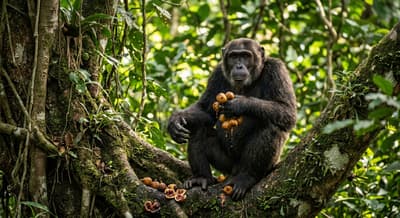
Your closest living relative has a drinking habit. Not the kind that involves a corkscrew or a bad decision at last call, but the kind that involves climbing a fig tree at sunrise and eating ten pounds of fruit before noon. According to a 2025 study published in Science Advances, wild chimpanzees consume roughly 14 grams of pure ethanol every day just from eating ripe fruit.[1] Adjusted for their smaller body mass, that's the equivalent of nearly two standard American cocktails.
They don't stagger. They don't slur. They don't start fights or text their exes. The alcohol is spread across a full day of foraging, diluted through pounds and pounds of figs, plums, and berries. But it's there, consistently, in virtually every piece of fruit they pick.
The study, led by UC Berkeley graduate student Aleksey Maro and professor Robert Dudley, was the first to actually measure the ethanol content of fruits available to chimps in their native African habitats. Maro collected 21 species of fruit at two long-studied chimpanzee sites: Ngogo in Uganda's Kibale National Park (home to the largest chimp social group in Africa) and Taï National Park in Côte d'Ivoire. The average alcohol content across all sampled fruit was 0.26% by weight.[1] That sounds trivial until you consider that chimps eat roughly 4.5 kilograms of fruit per day, and fruit makes up about three-quarters of their diet.
The math is simple. The implications are not.
This study provides the strongest evidence yet for something Dudley has been arguing since 2000: the "drunken monkey" hypothesis. The idea is that human attraction to alcohol isn't a cultural accident or a modern vice. It's an inheritance, hardwired into our biology by tens of millions of years of primate fruit-eating.[2] Ethanol is a natural byproduct of yeast fermenting the sugars in ripe fruit. Primates who could detect it, tolerate it, and metabolize it efficiently had an edge: the smell of alcohol led them to the ripest, most calorie-dense food in the canopy.
Dudley published a book on the theory in 2014, and for years the idea drew skepticism from primatologists who insisted chimps didn't eat fermented fruit.[3] The new data settles that debate with a breathalyzer. Or rather, with a portable gas chromatograph, a semiconductor sensor, and a chemical assay, all of which Maro lugged through the Ugandan and Ivorian rainforests to test freshly fallen fruit on-site.
The genetic evidence is equally compelling. Around 10 million years ago, the common ancestor of humans, chimps, and gorillas underwent a single mutation in the ADH4 enzyme (the one responsible for metabolizing ethanol). That mutation boosted alcohol-processing efficiency roughly 40-fold.[4] The timing coincides with a period when these ancestors were becoming more terrestrial, spending more time on the ground where fallen, fermenting fruit accumulates. It's as if evolution saw a new food source lying on the forest floor and upgraded the hardware to handle it.
Here's the unexpected angle: chimps may not just tolerate alcohol in their food. They might prefer it. In a 2016 study at Dartmouth, captive aye-ayes and slow lorises offered nectar with varying alcohol concentrations drained the high-alcohol options first, then kept returning to the empty containers as if hoping for a refill.[5] In Panama, spider monkeys were documented eating alcohol-rich fermented fruit and excreting ethanol metabolites in their urine.[6] The pattern holds across species and continents: when primates encounter boozy fruit, they don't avoid it. They go back for seconds.
Dudley suspects ethanol works as both a sensory cue and a feeding stimulant. The smell of alcohol carries far and fast through dense vegetation, acting like a dinner bell for fruit that's ripe and sugar-rich. Once consumed, the mild buzz may trigger what's known as the aperitif effect: a slight increase in appetite that encourages the animal to eat more, consuming extra calories that could mean the difference between surviving a lean season and not.[2]
None of this excuses your third glass of wine on a Tuesday. But it reframes the question. Humans didn't invent the desire for alcohol when we started brewing beer around 13,000 years ago. We inherited it from ancestors who were quietly fermenting their way through the Miocene. The modern problem isn't that we like alcohol. It's that we learned to concentrate it far beyond anything a fig tree could produce, and our ancient metabolic machinery was never built for that volume.
"Human attraction to alcohol probably arose from this dietary heritage of our common ancestor with chimpanzees," Maro told UC Berkeley News.[1] In other words, the next time you pour yourself a drink, you're honoring a tradition that predates language, tools, and fire. Your primate brain is simply doing what it evolved to do: following the scent of ripe fruit to its logical, slightly tipsy conclusion.
Sources
- In the Wild, Chimps Likely Ingest the Equivalent of Several Alcoholic Drinks Every Day — UC Berkeley News
- Human Evolution and Dietary Ethanol — Nutrients (PMC)
- Drunken Monkey Hypothesis — Wikipedia
- Hominids Adapted to Metabolize Ethanol Long Before Human-Directed Fermentation — PNAS (2014)
- Aye-Ayes and Slow Lorises Prefer Alcohol — Dartmouth News
- Monkeys Routinely Eat Fruit Containing Alcohol — UC Berkeley News