
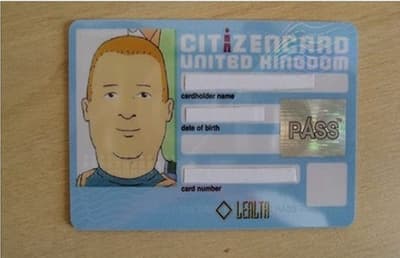
Imagine you are a retail clerk. The shift is dragging, the fluorescent lights are humming, and a teenager approaches your counter. They slide a piece of plastic across the laminate. You glance down, expecting a standard driver's license or a passport. Instead, you are staring into the eyes of a cartoon boy—a boy with an oversized head, a tiny torso, and a look of permanent, wide-eyed bewilderment.
It isn't a prank or a piece of surrealist performance art. It is a fake ID, and the face on it belongs to Bobby Hill, the ten-year-old protagonist of the animated series King of the Hill. And yet, in one of the most absurd lapses in retail security ever recorded, that cartoon character was able to walk into multiple stores and walk out with a cold beer.
The Undercover Audit
To understand how this happened, one must look at the mechanics of the operation. This wasn't a random occurrence; it was the result of a calculated, undercover sting conducted by Nottinghamshire County Council Trading Standards [1]. The goal was simple: test whether local retailers were adhering to strict age-verification laws designed to keep alcohol out of the hands of minors.
The council sent in an undercover operative—a teenager—to act as the test subject. The tools provided for this mission were almost comedically inadequate. The teen carried an ID that didn't just look "suspicious"; it was fundamentally impossible. Not only was the photograph a literal drawing of a fictional character, but the card explicitly stated the bearer was 17 [1]. In an era of high-definition security and rigorous compliance training, the premise was a recipe for absurdity.
A Systemic Failure
When the results of the operation were released, they painted a picture of a retail landscape that was, at best, dangerously negligent. Out of 22 different stores tested by the council, the failure rate was staggering [1].
More than half of the establishments failed the test in one of two ways. Some retailers didn't ask for identification at all, handing over the alcohol with nothing more than a transaction. Others did ask for ID, looked directly at the face of Bobby Hill, and—without a second thought—accepted the fake documentation as legitimate [1]. In total, the undercover teen successfully purchased alcohol in six different locations using nothing but a cartoon character and a bit of audacity.
There is a certain irony in the scale of the failure. We often assume underage drinking is a problem solved by better technology—scanners, biometric checks, or more sophisticated forged documents. But this incident proved that even the most advanced security in the world is useless if the person behind the counter isn't actually looking at what is right in front of them.
The Aftermath of the Absurd
The fallout from the Nottinghamshire sting served as a blunt wake-up call for local businesses. It highlighted a "compliance gap" that went far beyond the simple mistake of a tired employee; it pointed to a systemic lack of vigilance that allowed a cartoon character to bypass the law entirely.
While the story has since become a piece of internet folklore—a perfect example of the "you can't make this up" variety of news—the reality behind it remains a sobering lesson in accountability. It serves as a reminder that the thin line between a regulated society and total chaos often rests on the smallest, most mundane details: a glance, a check, and the simple decision to actually look at the person standing in front of you.