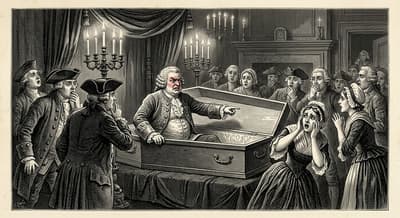
In the summer of 1798, roughly 3,000 people gathered in Newburyport, Massachusetts, to mourn a man who was not dead.
Timothy Dexter had organized the whole affair himself. The mahogany coffin. The candles. The black drapes. He had invited friends, neighbors, and curious strangers to pay their respects, and they had come in droves to the mansion of a man so rich, so outrageous, and so despised by polite society that his death - even a fake one - felt like news.[1]
From a hidden vantage point upstairs, Dexter watched the proceedings. He was looking for something specific: genuine grief. Evidence that the world would miss him. What he found instead made him furious.
His wife was not crying.
Dexter emerged from hiding, descended into the kitchen where she stood dry-eyed, and caned her in front of the guests.[2]
It is one of the strangest scenes in early American history - and it belongs to a man who produced nothing but strange scenes.
Born in 1747 to a poor family in Malden, Massachusetts, Dexter dropped out of school at eight and apprenticed as a tanner.[1] He should have died in obscurity. Instead, through a sequence of absurd accidents, he became one of the richest men in New England.
After the Revolution, he bought massive quantities of depreciated Continental currency everyone else considered worthless. When Hamilton's financial plan redeemed those notes at par, Dexter was suddenly rich.[3] It was the first of many idiotic decisions that somehow worked out.
Rivals told him to ship bed warmers to the West Indies. His captain sold them as ladles to the molasses industry at a handsome profit.[1] When enemies suggested he send coal to Newcastle, Dexter did it. His ships arrived during a miners' strike, and the coal sold at a premium.[2] He shipped cats to the Caribbean; planters snapped them up as rat killers.[1]
The more outrageous the venture, the better it went. Dexter decided he was touched by providence - then that he was God.
He bought the grandest mansion in Newburyport and filled its grounds with forty wooden statues of famous men - Washington, Jefferson, Napoleon, William Pitt - and himself, bearing the inscription: "I am the first in the East, the first in the West, and the greatest philosopher in the Western World."[1] He instructed children to call him Lord and paid them a quarter for the privilege. He told dinner guests his wife was dead and that the woman living in his house was merely her ghost.
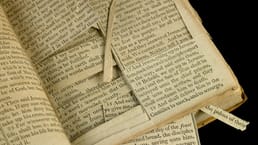
In 1802, he published a book. It contained no punctuation. Critics complained. Dexter responded in a subsequent edition by adding a page of nothing but periods, commas, and exclamation points, with a note explaining that readers could add them wherever they liked: "thay may peper and solt as they please."[3]
The mock funeral was peak Dexter: a man so insecure beneath his bluster that he needed to manufacture evidence of his own worth. He had spent decades chasing the respect of people who found him ridiculous. His wife's stoicism at the fake wake was not just an insult - to Dexter, it was confirmation of his worst fear. That even the person who shared his bed and his fortune didn't really mourn for him.
Dexter died for real in 1806, at 59. His wife, we can only assume, did not cry at that funeral either.
What makes Dexter so compelling, two centuries later, is not the eccentricity itself - it's the gap between the man's relentless performance and his obvious need for validation. He built wooden statues of himself. He faked his own death. He wrote a book demanding to be taken seriously and couldn't be bothered to add a single comma. Every bizarre move was, at its core, the same move: notice me.
In that sense, "Lord Timothy Dexter" wasn't so different from anyone chasing clout with increasingly unhinged stunts. He was just doing it in 1798, with a mahogany coffin and a cane.