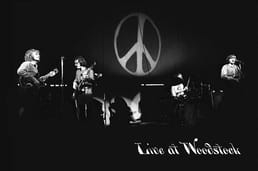

On August 15, 1969, thirty-two acts began playing outdoors on a sloping alfalfa field in Bethel, New York, 60 miles southwest of the town of Woodstock [1]. The field belonged to Max Yasgur, a dairy farmer who was the largest milk producer in Sullivan County [5]. More than 460,000 people arrived over three days despite overcast skies and sporadic rain [1].
The festival had lost earlier venues before it reached Bethel. Organizers first planned to hold it in the town of Woodstock on land owned by Alexander Tapooz, and local residents rejected the idea [1]. Wallkill then withdrew, taking with it a $10,000 deposit the promoters had already put down [2][6]. Saugerties was another option that fell through [6]. Yasgur leased 600 acres for a reported $75,000, a sum that published accounts do not agree on [4][5].
Yasgur was born in New York City on December 15, 1919, to Russian Jewish immigrants and grew up on the family farm in Maplewood, New York [5]. He earned a degree in real estate law at New York University before returning to farming [5][6]. By the late 1960s he ran ten farms totaling 2,000 acres, with a peak herd of 650 cattle, a pasteurization plant and door-to-door delivery routes [5]. He was also a registered Republican who supported the Vietnam War [5].
Opposition in Bethel arrived quickly. Signs around town read, "Don't buy Yasgur's milk. He loves the hippies" [4][6]. Some neighbors threatened arson, a boycott of his dairy products and physical attack [4]. Miriam Yasgur said the sign settled the matter: "When Max saw that, I knew darned well he was going to let them have their festival" [4][6]. At a town board meeting he argued that American soldiers had died so that the concertgoers could do as they pleased, then asked whether the town would throw him out for being a Jew [6].
Yasgur expected about 40,000 people and got roughly 460,000 [1][5]. He appeared on stage during the festival's second day and addressed the crowd [4]. Retrospectives of 1969 in music treat the festival as the year's defining concert, more significant than the violence at Altamont [3].
When Yasgur learned that neighbors were selling water to thirsty concertgoers, he hung a "FREE WATER" sign on the side of his barn that faced the road [4]. He told his children to fill every empty milk bottle at the dairy plant and hand them out along with the milk, cheese and butter on hand [5].
The owners of the adjacent farm sued Yasgur for $35,000 over damage they attributed to festivalgoers [4]. He settled for $50,000 and sold the farm less than two years later [5]. Yasgur died of a heart attack on February 9, 1973, at 53 [5]. Rolling Stone ran a full-page obituary, one of the few given to a non-musician [5]. Joni Mitchell's 1970 song "Woodstock" named his farm in its chorus [6], and the festival site joined the National Register of Historic Places in 2017 [1]. Bethel, estimated at 3,959 residents in 2020, still draws visitors to the field [2].