You survive measles. The fever breaks, the rash fades, and your body moves on. Except it doesn't. While you were fighting off one virus, that virus was quietly deleting years of hard-won immunity from the rest of your immune system. Diseases you'd already beaten? Your body just forgot how to fight them.
Scientists call it "immune amnesia," and it might be the most underreported danger of a disease most people think of as a childhood nuisance with spots.
The Discovery That Changed Everything
For decades, doctors noticed something strange. Children who recovered from measles seemed to get sicker more often in the years that followed. Not from measles itself, but from everything else: pneumonia, infections, diseases they should have been protected against. The pattern was there, but nobody could explain it.
Then, in 2019, immunologist Michael Mina and geneticist Stephen Elledge at Harvard Medical School cracked it open. Using a tool called VirScan, which can read an entire immune history from a single drop of blood, they tested 77 unvaccinated children in the Netherlands before and after measles infection.[1] What they found was staggering: measles wiped out between 11% and 73% of the children's protective antibodies. Not measles antibodies. All the other ones.
Flu antibodies. Herpes antibodies. Pneumonia antibodies. Years of accumulated immune intelligence, gone.[2]
A Virus That Hunts Your Memory Cells
Most infections mess with your immune system temporarily. Influenza damages your airways, leaving you vulnerable to bacterial pneumonia for a few weeks. But measles specifically targets and destroys the memory cells your immune system spent years building.[3]
Your immune system's memory works like a library of mugshots. Every pathogen you've ever fought gets catalogued by specialized B cells and T cells so your body can recognize and destroy them instantly if they return. Measles virus has an eerie affinity for a receptor called CD150, found on the surface of these exact memory cells.[3] It latches on, hijacks them, and uses them to replicate. When your immune system eventually clears the measles infection, it does so by killing its own infected memory cells. The virus is gone, but so are your records.
"Imagine that your immunity against pathogens is like carrying around a book of photographs of criminals, and someone punched a bunch of holes in it," Mina told the Harvard Gazette. "It would then be much harder to recognize that criminal if you saw them."[2]
The Trojan Horse
When you breathe in measles, the virus first infects immune cells called alveolar macrophages in your lungs. Normally, these cells grab pathogens and shuttle them to the lymph nodes to trigger an immune response. Measles hitches a ride on that very transport system, entering the space where immune memories are formed and stored.[4]
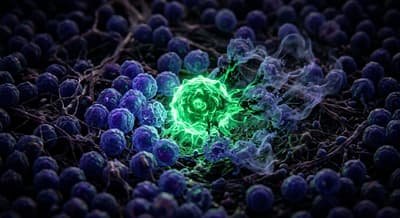
In primate studies, researchers gave monkeys fluorescently labeled measles virus that made infected cells glow green. The germinal centers throughout the body, the warehouses of immune memory in the gut, bone marrow, and lymphatic tissue, were glowing. "Everything that's green is just dying," Mina explained.[4]
The Long Shadow
What replaced those destroyed memory cells? New lymphocytes, and lots of them. But they all had only one memory: measles. The immune system appeared normal on standard tests, humming along and forming new memories just fine. But it had lost its history.[4] Mina's earlier epidemiological work, published in Science in 2015, showed that children who'd had measles continued dying at elevated rates for two to three years afterward, not from measles, but from infections their immune systems should have handled easily. Measles may have been responsible for up to 50% of all childhood infectious disease deaths, because it left survivors defenseless against everything else.[2]
The measles vaccine doesn't protect against one disease. By preventing immune amnesia, it protects against all the diseases your body has already learned to fight. And researchers now suggest that anyone who does contract measles should consider getting re-vaccinated against everything else afterward, because their immune system may need to start over.[1]
One virus. One infection. And your body forgets everything it ever knew.