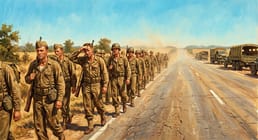
In August 1966, Robert McNamara stood before a crowd and announced that the United States military would begin accepting men it had previously deemed unfit to serve. He framed it as an act of generosity - a way to "salvage" the nation's poor "first for productive military careers and later for productive roles in society." The program was called Project 100,000, named after how many men he planned to recruit in its first year.[1]
By the time it ended in December 1971, between 320,000 and 354,000 men had been inducted under the program. Most of them were sent to Vietnam. They died at three times the rate of other American soldiers serving in the same war.[2]
The Test They Failed
Every potential recruit to the U.S. military takes the Armed Forces Qualification Test, a standardized exam that measures basic aptitude - reading, arithmetic, spatial reasoning, mechanical comprehension. Scores are grouped into categories. Category I is the top. Category V is the bottom. Before Project 100,000, anyone scoring in Category IV (the 10th to 30th percentile) or below was turned away. They were considered unable to function safely in a military environment.[3]
McNamara lowered the threshold to the 10th percentile. In some cases, even lower.[4]
The men who came through the door were officially designated "New Standards Men." Their fellow soldiers had other names for them. "McNamara's Morons." "McNamara's Misfits." The "Moron Corps."[2]
Men Who Couldn't Tie Their Shoes
Hamilton Gregory was a serviceman who witnessed the program firsthand. He later wrote the definitive account, McNamara's Folly: The Use of Low-IQ Troops in the Vietnam War, published in 2015. What he documented is difficult to read.[2]
Many of these men were functionally illiterate. They couldn't read the paperwork they signed at induction. Some didn't understand they were enlisting for military service at all. Fellow soldiers had to help them tie their boots, make their beds, write letters home. They couldn't read maps or follow written orders. Some had mental disabilities so severe they belonged in care facilities, not combat zones.[2]
President Lyndon Johnson, who supported the program as part of his War on Poverty agenda, privately referred to these recruits as "second-class fellows."[5]
And yet: once inducted, Project 100,000 soldiers were put through the exact same training as everyone else. The military made no accommodations. That was part of the design - to do otherwise, Pentagon officials argued, would invalidate the experiment. Because that's what it was. An experiment, with monthly anonymized reports filed on each man's "progress."[3]
Cannon Fodder By Design
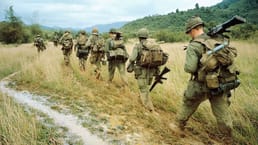
The results were predictable. Project 100,000 men couldn't qualify for technical training - the kind that kept soldiers off the front lines. So they were funneled into infantry, into combat roles, into the jungle. They were reassigned eleven times more often than their peers. They required remedial training at seven to nine times the normal rate.[6]
They died at three times the rate of other American troops in Vietnam.[2]
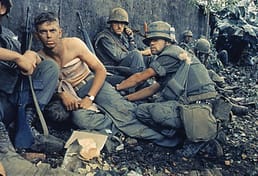
An estimated 5,478 Project 100,000 men were killed in action. Roughly 20,000 more were wounded.[2] Myra MacPherson, reviewing McNamara's memoir for the Washington Monthly in 1995, wrote that the program "offered a one-way ticket to Vietnam, where these men fought and died in disproportionate numbers" - providing "the necessary cannon fodder to help evade the political horror of dropping student deferments or calling up the reserves."[7]
That's the quiet arithmetic of Project 100,000. By sending men who scored in the bottom percentiles of a basic aptitude test, the Pentagon could avoid drafting college students - men whose families had political influence, whose deaths would generate outrage. The men of the Moron Corps had no such protection.
After the War
For the survivors, military service delivered none of what McNamara had promised. A 1989 Department of Defense-sponsored study found that Project 100,000 veterans earned $5,000 to $7,000 less per year than comparable men who never served. They were more likely to be unemployed. More likely to be divorced. Less likely to own a business. They had lower educational attainment than their civilian peers - the opposite of what the program was supposed to achieve.[3]
First Lieutenant Herb DeBose, who served in Vietnam, later recalled: "Many under me weren't even on a fifth-grade level. I found out they could not read. No skills before, no skills after. The army was supposed to teach them a trade in something - only they didn't."[7]
McNamara never publicly apologized for the program. In his 1995 memoir, In Retrospect, he expressed regret about Vietnam broadly but did not address Project 100,000 in any meaningful way. Kelly Greenhill, writing in the New York Times in 2006, delivered the simplest verdict: "Project 100,000 was a failed experiment. It proved to be a distraction for the military and of little benefit to the men it was created to help."[6]
But "failed experiment" implies that success was possible. That there was some version of this idea that could have worked - some way to send illiterate men with cognitive disabilities into a war zone and have it turn out well. The failure wasn't in the execution. It was in the premise. McNamara dressed up a manpower shortage as philanthropy, and 354,000 men paid for it.
Sources
- Project 100,000: New Standards Program - RAND Corporation
- McNamara's Folly: The Use of Low-IQ Troops in the Vietnam War - Hamilton Gregory (2016 lecture)
- Effects of Military Experience on the Post-Service Lives of Low-Aptitude Recruits - Laurence et al. (1989)
- Refilling the Pool - TIME Magazine (1966)
- Project 100,000 - Wikipedia
- Don't Dumb Down the Army - Kelly M. Greenhill, The New York Times (2006)
- McNamara's 'Other' Crimes - Myra MacPherson, Washington Monthly (1995)