Benjamin Franklin was known for many things in his life. He was an author, a postmaster, an ambassador, and one of the United States’ Founding Fathers. But he was more of a curious inventor, creating a variety of nifty gadgets. Did you know he can also calm puddles with a touch of his cane?
Translate to Portuguese: "Benjamin Franklin era conhecido por muitas coisas em sua vida. Ele foi autor, carteiro, embaixador e um dos Pais Fundadores dos Estados Unidos. Mas ele era mais um inventor curioso, criando uma variedade de engenhocas úteis. Você sabia que ele também pode acalmar poças com um toque de sua bengala?" Make sure to keep HTML entity ’ for apostrophe? In original they used ’ for apostrophe. Should we keep same? In translation we can use the same entity for apostrophe. For "Estados Unidos’" we need to keep entity after "Estados Unidos". So "Estados Unidos’"? Actually original: "United States’ Founding Fathers". That is "United States’". So we need "Estados Unidos’". So we keep entity. Thus: "Benjamin Franklin era conhecido por muitas coisas em sua vida. Ele foi autor, carteiro, embaixador e um dos Estados Unidos’ Pais Fundadores. Mas ele era mais um inventor curioso, criando uma variedade de engenhocas úteis. Você sabia que ele também pode acalmar poças com um toque de sua bengala?" Wait "Estados Unidos’ Pais Fundadores" is awkward. Better: "um dos Pais Fundadores dos Estados Unidos". The apostrophe is after "Estados Unidos". So we could write "dos Estados Unidos’". Actually the apostrophe is a right single quote after "United States". In Portuguese, we would say "dos Estados Unidos". No need for apostrophe. But we must keep entity? The instruction is to translate, not preserve entity if not needed. But we can keep entity for apostrophe if we use it. Safer to keep same entity usage: "dos Estados Unidos’". That would be weird. Maybe we can just write "dos Estados Unidos". The entity is not required. The instruction: keep all HTML tags intact. Not about entities. So we can adjust text. I'll produce natural Portuguese. Next paragraph:When Benjamin Franklin lived in London in 1762, he carried a bamboo cane that secretly contained about a pint of oil. He used the oil whenever he was near a body of water, tricking his friends to think he could calm the waters.
Translate: "Quando Benjamin Franklin vivia em Londres em 1762, ele carregava uma bengala de bambu que secretamente continha cerca de meio litro de óleo. Ele usava o óleo sempre que estava perto de um corpo d'água, enganando seus amigos para que acreditassem que ele podia acalmar as águas." Note: pint ~ 0.473 L, but we can keep "uma pinta". In Portuguese, "uma pinta". Could translate as "cerca de uma pinta de óleo". Let's keep "cerca de uma pinta de óleo". Use "cerca de uma pinta". So: "cerca de uma pinta de óleo". Keep apostrophe in "d'água". Use HTML entity? Not needed. Next heading:Benjamin Franklin’s Walking Stick
Translate: "Bengala de Benjamin Franklin". Keep entity? Use apostrophe? Could be "Bengala de Benjamin Franklin". No need for entity. So:Bengala de Benjamin Franklin
Next paragraph:Benjamin Franklin was sent to London as an ambassador for the Pennsylvania Assembly. While traveling on a ship that was part of a fleet of 96 sailing vessels, Benjamin took notice of the wakes created by two boats. He noticed that the wakes were incredibly smooth as if it wasn’t affected by the wind.
Translate: "Benjamin Franklin foi enviado a Londres como embaixador da Assembleia da Pensilvânia. Enquanto viajava em um navio que fazia parte de uma frota de 96 embarcações, Benjamin percebeu as ondas criadas por dois barcos. Ele notou que as ondas eram incrivelmente suaves, como se não fossem afetadas pelo vento." Note entity for "wasn't". We'll just translate. Next paragraph:Franklin grew curious as to why this was the case and quickly tried to find answers. He spoke to the captain, and the captain thought Franklin’s question was stupid since the sailors commonly see the phenomenon. The captain explained that the ships’ cooks probably emptied their greasy water right when the wakes were smooth.
Translate: "Franklin ficou curioso sobre o motivo disso e rapidamente tentou encontrar respostas. Ele falou com o capitão, e o capitão achou a pergunta de Franklin estúpida, já que os marinheiros costumam observar o fenômeno. O capitão explicou que os cozinheiros dos navios provavelmente despejavam sua água gordurosa exatamente quando as ondas estavam suaves." Note "ships’ cooks". We'll translate. Next paragraph:Franklin’s curiosity kicked in as he did not fully accept the captain’s answer. In his free time, he conducted his experiments during his stay in London. In the summer of 1772, Franklin and John Pringle visited William Brownrigg. The three visited a local lake Derwent Water, and soon enough, Franklin tricked the two that he could quiet waters.
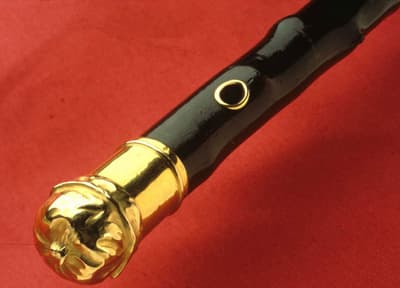
Translate: "A curiosidade de Franklin se intensificou ao não aceitar totalmente a resposta do capitão. No seu tempo livre, ele conduziu experimentos durante sua estadia em Londres. No verão de 1772, Franklin e John Pringle visitaram William Brownrigg. Os três foram a um lago local, o Derwent Water, e, em pouco tempo, Franklin enganou os dois ao fazer parecer que podia acalmar as águas." Next paragraph:Franklin devised a bamboo cane that can keep about a pint of oil in its hollow upper joint. With one push of the head, the cane would release oil from the bottom and into the water’s surface. It immediately quieted the waves of the water, making it look smooth as a looking glass. (Source: Physics Today)
Translate: "Franklin criou uma bengala de bambu que pode armazenar cerca de uma pinta de óleo em sua junta superior oca. Com um empurrão na cabeça, a bengala liberava o óleo da parte inferior para a superfície da água. Isso acalmava imediatamente as ondas, deixando a água tão lisa quanto um espelho. (Fonte: Physics Today)" Note keep link unchanged. Next heading:Franklin’s Other Inventions
Translate: "Outras invenções de Franklin". So:Outras invenções de Franklin
Next paragraph:Though Franklin’s walking stick was a novelty invention, he developed other nifty gadgets with practical applications. Here are some of the inventions credited to Franklin. (Source: Franklin Institute)
Translate: "Embora a bengala de Franklin fosse uma invenção de novidade, ele desenvolveu outras engenhocas úteis com aplicações práticas. Aqui estão algumas das invenções atribuídas a Franklin. (Fonte: Franklin Institute)" Next heading:Lightning Rod
Translate: "Para-raios". So:Para-raios
Next paragraph:This was perhaps the most famous invention Franklin was credited for and was the product of his accidental shock in his kite experiment in 1746. He noticed that a sharp iron needle dissipated electricity from a charged metal sphere and concluded it might
Franklin conseguiu validar sua conclusão, e logo os pára‑raios pontiagudos estavam no topo dos edifícios em todas as colônias. (Fonte: Franklin Institute)
Bifocais
Franklin ficou tanto míope quanto hipermetrope, uma condição normal para indivíduos que envelhecem. Logo ele teve dois pares de óculos, um para leitura e outro para visão à distância. Franklin rapidamente se cansou de trocar de um par para o outro, o que o levou a criar os óculos duplos, que conhecemos hoje como bifocais.
Ele cortou as lentes de ambos os óculos horizontalmente ao meio e combinou a lente para leitura e a lente para visão à distância em um único par. A lente para leitura ficava na parte inferior, enquanto a lente para visão à distância ficava na parte superior. (Fonte: Franklin Institute)
Harmônica de Vidro
Franklin também era curioso sobre música. Ao ouvir seu amigo tocar uma melodia com vários copos contendo diferentes quantidades de líquido e simplesmente esfregando as bordas com um dedo molhado, ele pensou que poderia fazer melhor.
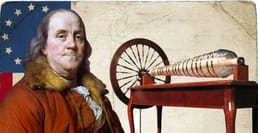
Logo ele inventou a harmônica de vidro, que se tornou tão popular que até a rainha francesa Maria Antonieta era conhecida por usá‑la. (Fonte: Fantastic Facts)