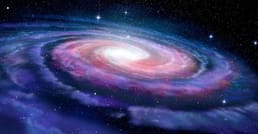
Somewhere near the center of our galaxy, drifting about 390 light-years from the supermassive black hole that anchors the Milky Way, there is a cloud of gas and dust that would taste like raspberries and smell like rum. This is not a metaphor. It is chemistry.
The cloud is called Sagittarius B2, and it is one of the largest molecular clouds in the galaxy - roughly 150 light-years across, with a total mass about three million times that of our Sun.[1] It sits in a violent neighborhood, bathed in radiation from newborn stars and the faint echo of ancient outbursts from Sagittarius A*, the black hole at the galaxy's heart.[1] And buried within its vast, freezing expanse of gas is a molecule called ethyl formate.
You have probably tasted ethyl formate without knowing it. It is the ester responsible for the flavor of raspberries and it carries the distinctive smell of rum.[2] On Earth, the U.S. Food and Drug Administration classifies it as generally recognized as safe.[2] In space, its presence inside Sagittarius B2 was confirmed in 2009 by a team led by Arnaud Belloche at the Max Planck Institute for Radio Astronomy, using the 30-meter IRAM radiotelescope in Spain.[3]
The discovery was almost accidental. Belloche's team was not hunting for the flavor of fruit. They were searching for amino acids - the molecular building blocks of life - sifting through nearly 4,000 distinct chemical signals radiating from the cloud. Among roughly 50 molecules they identified, ethyl formate and propyl cyanide stood out as the two largest organic molecules ever detected in deep space at the time.[3]
"It does happen to give raspberries their flavour, but there are many other molecules that are needed to make space raspberries," Belloche told The Guardian with dry understatement.[3]
The real significance is not the flavor. It is the size. Ethyl formate and propyl cyanide are roughly as large as glycine, the simplest amino acid. Their presence in a molecular cloud suggests that the chemical machinery of space can build molecules complex enough to be biologically relevant. "There is no apparent limit to the size of molecules that can be formed by this process, so there's good reason to expect even more complex organic molecules to be there," said Robin Garrod, Belloche's colleague at Cornell University.[3]
How does space build something as complex as a rum-flavored ester? The process starts with cold dust grains - tiny particles of silicon coated in a mantle of water ice and carbon compounds. These grains act like miniature chemistry labs. Simple molecules like ethanol land on the surface, bump into their neighbors, and link together into longer chains.[1] When the surrounding temperature rises - from a nearby star being born, say - the new compound evaporates off the grain and joins the cloud. Over millions of years, this quiet catalysis fills the void with organic complexity.
Sagittarius B2 has been especially generous. About half of all known interstellar molecules were first detected in this single cloud.[1] The list includes ethanol, vinyl alcohol, methanol, and dozens of other compounds. Some are building blocks of life. Others - carbon monoxide, hydrogen cyanide, ammonia - would kill you outright.[4]
And then there is the alcohol content. As science writer Marcus Chown calculated in New Scientist, Sagittarius B2 contains an estimated 1027 liters of alcohol at 200-proof strength - vastly more than has been distilled in the entire history of the human race.[5] The catch: it is mostly methanol, which will blind or kill you, smeared so thinly through space that you would need to trawl a volume the size of Earth to fill a single whisky glass.
So you cannot drink it. You certainly cannot reach it. But the raspberry rum cloud is something arguably more valuable than a cosmic cocktail. It is evidence that the universe is not just making stars - it is cooking the ingredients for life, one dust grain at a time.