Imagine a bustling market in Edo-period Japan. You strike up a conversation with a merchant, a farmer, or a craftsman. You ask for his name, expecting a lineage or a title that carries the weight of generations. But he pauses, looks at you, and offers only a single name. Perhaps it is Taro or Hanako. There is no family name—no "Smith" or "Jones" to anchor him to a clan or a history.
For the vast majority of the Japanese population for centuries, this wasn't a quirk of etiquette; it was the law. In the rigid social hierarchy of pre-modern Japan, surnames were a luxury, a piece of linguistic armor reserved exclusively for the nobility and the samurai class. If you weren't part of the elite, you simply didn't have one.
It wasn't until 1868, with the dawn of the Meiji Restoration, that the foundations of Japanese identity were upended. Seeking to modernize and centralize control, the government mandated that commoners adopt surnames. Suddenly, millions of people who had lived their entire lives without a family name were tasked with a profound question: Who are we?
The Great Naming Explosion
This mandate triggered a linguistic explosion. Because there was no central registry of "approved" names, choosing a surname became an exercise in practical necessity and sudden creativity. This explains why Japan today boasts a staggering diversity of names, with over 100,000 distinct surnames in circulation.
Inspiration was everywhere. Some chose names based on the land they tilled, turning geographic markers like mountains, rivers, or fields into permanent fixtures of their identity. Others chose based on their trade, transforming occupations into legacies. Then there were those who simply chose sounds or characters that felt right, creating a tapestry of names as varied as the Japanese landscape itself.
The Logic of the Kanji
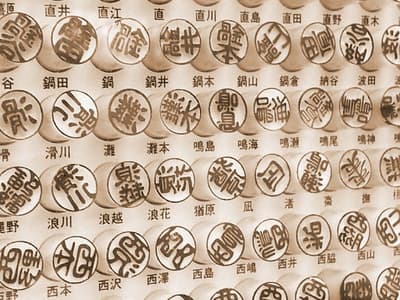
While the origins of these names are diverse, their written form is deeply structured. Most Japanese names are composed of kanji—logographic characters originally imported from China and adapted to the unique phonetics of the Japanese language[1].
This creates a fascinating duality: a name is not merely a sound, but a visual composition of meaning. When you see a name written in kanji, you aren't just reading a label; you are reading a story of symbols and historical context. It is this marriage of sound and symbol that gives Japanese nomenclature its profound depth.
The Battle of Order: East Meets West
As Japan stepped onto the global stage, a new conflict emerged—not of swords, but of syntax. In the Japanese language, the tradition is clear: the family name comes first, followed by the given name[1]. It is a system that prioritizes the collective—the family—over the individual.
However, as Japan engaged more deeply with Western nations throughout the 20th century, a subtle cultural concession took place. To cater to Western expectations, official policy often dictated that when writing names in the Roman alphabet, the order should be reversed. The family name was pushed to the end, making Japanese names appear to follow the Western "First Name, Last Name" convention.
For decades, this was the standard. But the tide is turning. In a move toward reclaiming cultural autonomy, the Japanese government announced in 2019 its intention to shift back to the traditional order in official settings[1]. It is a quiet revolution, an insistence that even in a globalized world, the family—the root from which the individual grows—should always come first.
The Placeholder: Yamada Taro
To understand the mechanics of these names, linguists often use "placeholder" names—the linguistic equivalent of "John Smith." If you see the name Yamada Taro (山田太郎) in a textbook, it is not a specific historical figure; it is a generic, quintessential male name used to illustrate how the system works.
Just as Yamada Taro serves as the standard male placeholder, Yamada Hanako (山田花子) serves as the female counterpart. They are the ghosts in the machine of the Japanese language, helping us navigate a naming system born from a massive shift from a caste-based society to a modern nation-state.