You use the word "scientist" without thinking about it. But the first time it appeared in print, it was attached to a woman who was mostly denied the education her brothers received.[1][2]
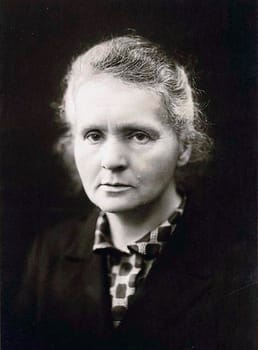
Mary Somerville, born in Scotland in 1780, was taught to read but not to write, and she did not attend school until she was about 10.[1][2][3] The plan for her life was ordinary and restrictive: learn the domestic skills expected of a respectable young woman, then stop asking awkward questions. She ignored that plan almost immediately.[1][3]
Somerville educated herself from family bookshelves, worked through Euclid, and hunted down anyone who could help her with Latin, algebra, and astronomy.[1][3] In 1831 she published Mechanism of the Heavens, a clear English explanation of Pierre-Simon Laplace's dense celestial mechanics. Britannica notes that leading British mathematicians and astronomers treated the book as a serious achievement, not a curiosity.[2]
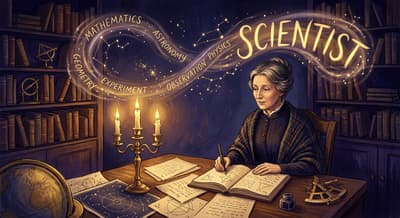
Three years later she published On the Connexion of the Physical Sciences, an ambitious book showing how astronomy, physics, geography, and meteorology fit together.[1][2] Reviewing that book in 1834, William Whewell reached for a new label. "Philosopher" was too broad, and "man of science" was awkward for Mary Somerville, so he introduced the word "scientist" in print.[1][4]
That is the remembered anecdote. The more interesting part is why Somerville forced the language to stretch in the first place. She was not known for one grand experiment. She was known for synthesis, taking discoveries scattered across disciplines and making them legible to general readers and useful to working researchers.[2][4] St Andrews credits her work with influencing James Clerk Maxwell, and Britannica notes that a later edition of her book helped spur the calculations that led to Neptune's discovery.[2][3]
In 1835, Somerville and Caroline Herschel became the first female honorary members of the Royal Astronomical Society.[1][2] In 1866, when John Stuart Mill presented Britain's first mass women's suffrage petition to Parliament, Somerville's signature was the very first on it.[1] She was still pushing against the limits placed on women well into her eighties.[1]
That is why this still matters. Mary Somerville did not just help explain science. She helped create the cultural space for a scientist to be imagined as something other than a man in a lecture hall. Every time you say the word, you are echoing a small change in language that history had to make because one woman's intellect had become impossible to ignore.[1][4]