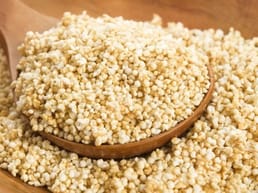
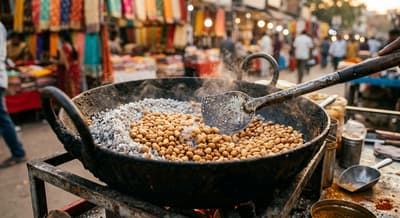
Somewhere in India right now, a street vendor is stirring peanuts through a massive iron wok full of scorching grey salt. No oil. No butter. Just a kilo of coarse salt heated past 200°C, and a metal spatula that hasn't stopped moving in hours. The peanuts come out golden, impossibly crispy, and barely salty at all. This is hot salt frying, and it predates your kitchen by roughly two centuries.
The technique is simple enough to make you suspicious. Fill a heavy wok with coarse salt, crank the heat, and once the salt hits a shimmering, golden-brown state, toss in your dry ingredients: peanuts, chickpeas, popcorn kernels, even eggs in their shells. The salt grains act like thousands of tiny heat conductors, surrounding the food and transferring energy from every angle at once. Think of it as deep frying's older, leaner sibling: same principle of total heat immersion, none of the fat.[1]
The earliest written references to this method trace back to at least the 1830s. Dr. Francis Buchanan Hamilton, a Scottish physician surveying Bengal for the East India Company, documented the production of muri (puffed rice) in the Dinajpur district in 1833. Villagers heated coarse salt in iron vessels, then tossed in parboiled rice, which exploded into airy puffs on contact. The salt was sieved off and reused. The rice became breakfast.[2] Half a century later, A.H. Church catalogued the same technique in his 1886 study Food-Grains in India, noting its prevalence across the subcontinent.[3]
Today, hot salt frying is the backbone of street food across Bangladesh, India, Nepal, Pakistan, China, and Sri Lanka. In Pakistan, whole corn cobs get buried in heated rock salt and turned periodically until the kernels are tender and faintly smoky. In China, vendors fill woks with black sand (which works on the same principle) to roast chestnuts, the sand darkening over time from carbonized food particles.[1] In India, the technique makes everything from puffed rice for bhelpuri to the roasted chana you buy in paper cones at railway stations.
Here is the part that surprises people: the food does not taste salty. Because the ingredients are dry and the cooking time is short, almost no sodium actually penetrates the food. The salt stays in the wok. Once you sieve the finished product, the grains fall right off. A handful of salt-fried peanuts contains far less sodium than a bag of commercially seasoned chips, which are sprayed with fine salt powder after oil-frying.[4]
None of this was news to a few billion people in South and East Asia. But in early 2025, it became very much news to TikTok. A video by Brazilian food creator Roice Bethel showing him "deep frying" popcorn in a pan of heated rock salt collected over 16 million views. Comments flooded in, most from viewers convinced the result would be inedibly salty. BuzzFeed writer Micah Siva tested it at home and confirmed the popcorn came out "ever so subtly salted" with a smell "oddly like movie theatre popcorn."[5][6]
The science checks out. Salt has a high specific heat capacity, meaning it absorbs and retains thermal energy effectively. Unlike air (which loses heat fast) or oil (which soaks into food), salt delivers consistent, aggressive, all-surface-contact heat while staying firmly on the outside. The result is rapid moisture removal, which is what gives fried food its crunch. You get the Maillard reaction, the crispy shell, the satisfying snap, all without a single calorie of added fat.[4]
There is a catch, of course. Hot salt frying only works on dry ingredients: kernels, legumes, nuts, grains, shell-on eggs. Do not attempt it with chicken wings. And the salt is reusable dozens of times, which makes the technique absurdly cheap. In many parts of rural Asia, that was the entire point. Oil was expensive. Salt was not.
So the next time you see a TikTok "hack" go viral, consider the possibility that it was a Tuesday afternoon in Bengal two hundred years ago. Sometimes the future of cooking is just the past, finally getting the algorithm it deserves.
Sources
- Hot salt frying — Wikipedia
- A Geographical, Statistical, and Historical Description of the District of Dinajpur — Dr. Francis Buchanan Hamilton (1833)
- Food-Grains in India — A.H. Church (1886)
- Salt Frying: Master The Zero-Oil Street Style Secret — Slurrp
- I Tested The Viral Salt Frying Method — BuzzFeed
- Forget oil and butter: This is the latest cooking trend for frying food — AS.com