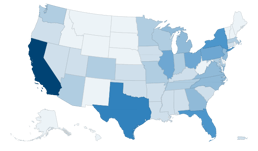

In January 2018, a survey of 2,000 Americans conducted by OnePoll for the luggage company Victorinox reported that 11 percent of respondents had never traveled outside the state where they were born [1]. The same poll found that 54 percent had visited 10 states or fewer [1]. Roughly a third, 32 percent, said they either did not own travel luggage or could not remember ever buying any [1].
Forty percent of those respondents said they had never left the United States, and more than half had never owned a passport [1]. Later surveys put the figures lower. A 2025 Pew American Trends Panel survey found that 23 percent of Americans had never visited a foreign country, while 41 percent had visited no more than one country outside the United States and 27 percent had visited at least five [7]. A 2025 survey by Scenic Group and Talker Research found that 32 percent had never traveled outside the country, and a 2013 survey had put the share at 54 percent [7].
The 2018 poll also recorded 13 percent who had never flown in an airplane [1]. Desire was not the missing ingredient: 76 percent wanted to travel more than they currently did, 85 percent said they like to experience new things, and nearly 60 percent had a list of places they wanted to see [1]. The researchers attributed the gap to finances and to people feeling unprepared or ill-equipped to go [1].
Domestic tourism rose sharply during the COVID-19 pandemic, when countries closed their airports to slow the spread of the virus [3]. The word staycation entered wide British use in the late 2000s, when reporters covered a rise in domestic holidays during the Great Recession and a weak pound made foreign travel costlier [3]. In countries as large as the United States, domestic tourism plays a very large role in the total tourism sector [3].
Travel and tourism generated $840 billion in value added in 2023, equal to 3.03 percent of U.S. gross domestic product, and supported 10.0 million jobs, 6.5 million of them direct [2]. New York City was the most visited destination in the United States in 2023, followed by Miami, Los Angeles, Orlando, and San Francisco [2]. The country attracts the third-highest number of tourists in the world, after France and Spain, but visitors spend more money in the United States than in any other country, a gap that may reflect longer stays [2].
By 1840, 2,800 miles of rail track had been completed in the United States, and by 1860 every major eastern city was linked by rail [2]. In 1869 the first transcontinental link was completed, making it possible for people in the East and Midwest to visit the West Coast [2]. Air travel then reshaped the market between 1945 and 1969 [2].
The Census Bureau's Current Population Survey measures mobility by comparing each person's residence at the time of the March survey with the residence one year earlier, sorting people into non-movers and movers by county, state, region, or origin abroad [5]. Travel behavior researchers rely on household travel surveys, including the National Household Travel Survey, which runs about every five years with limited spatial detail [4].
Globally, about 1.4 billion tourists traveled internationally in 2024, roughly 99 percent of the 2019 level and 11 percent above 2023, with receipts near $1.6 trillion [6]. UN Tourism counted around 1.3 billion international arrivals in 2023, about 88 percent of pre-pandemic levels [6]. The World Health Organization estimates that up to 500,000 people are in flight at any one time [6].