Imagine knowing exactly how to save someone's life, having the skill in your hands, and choosing not to. Not because you don't care. Because if you do, everyone you love dies instead.
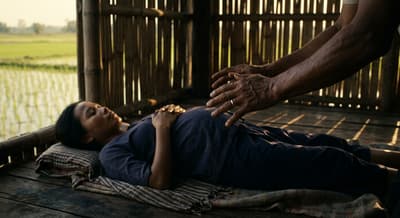
That was the impossible choice facing Haing S. Ngor in 1978, a Cambodian obstetrician watching his wife, Chang My-Huoy, struggle through a fatal labor complication on a rice farm in rural Cambodia. She needed a cesarean section. He had performed the procedure countless times. But under the Khmer Rouge regime, revealing that you were a doctor was a death sentence.[1]
Year Zero
When Pol Pot's Khmer Rouge seized Phnom Penh in April 1975, they called it "Year Zero," a forced reset of Cambodian society. An educated person was a contaminated person, and the cure was a bullet or a shallow grave. Doctors were particularly suspect.[2]
Ngor survived by lying. He told the Khmer Rouge he was a taxi driver. He hid his education, his medical training, even the fact that he wore glasses. Three separate times, he endured torture to extract a confession about his real profession. He stuck to the story.[2]
To stay alive, he ate beetles, termites, and scorpions. He watched friends and colleagues disappear. And then came the worst moment of his life: his wife going into labor, the baby in distress, and the knowledge that he could fix it, if he were willing to kill everyone around him by doing so.[1]
Chang My-Huoy and their unborn child both died. He never remarried.[4]
From Refugee Camp to the Academy Awards
After the Vietnamese invasion toppled the Khmer Rouge in 1979, Ngor crawled to a refugee camp in Thailand with his niece. He worked as a physician there before immigrating to the United States in 1980, where he became a counselor at a refugee resettlement agency, unable to resume his medical practice.[1]
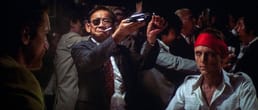
A casting director named Pat Golden spotted him at a Cambodian wedding and thought he had the right face for a film being made about the fall of Cambodia.[5] The movie was The Killing Fields, directed by Roland Joffé, and the role was Dith Pran, a real Cambodian photojournalist who survived the regime. Ngor had never acted before. Not once in his life.
He wasn't initially interested. But then the filmmakers told him more about Dith Pran's story, and something clicked. Ngor remembered a promise he had made to his dying wife: that he would tell the world what happened in Cambodia.[1]
He won the Academy Award for Best Supporting Actor. He was the first actor of Asian descent to win the award, and only the second non-professional actor ever to win an Oscar, after Harold Russell in 1947.[3] During filming, scenes regularly triggered his own post-traumatic stress. Dith Pran's nightmare wasn't acting for Ngor. It was memory.[5]
"I wanted to show the world how deep starvation is in Cambodia, how many people die under communist regime," Ngor told People magazine. "My heart is satisfied. I have done something perfect."[1]
The Locket
Ngor spent the rest of his life advocating for Cambodia, publishing his autobiography (A Cambodian Odyssey, 1987) and using his fame to keep the genocide in public consciousness.[3]
On February 25, 1996, he was shot and killed outside his home in Los Angeles' Chinatown. Three members of a street gang were convicted of the murder. Prosecutors said it was a botched robbery. But the detail that haunts the case is this: Ngor willingly handed over his gold Rolex. What he refused to give up was a locket containing a photograph of Chang My-Huoy.[1]
He survived a genocide by pretending not to be a doctor. He won an Oscar by being exactly who he was. And he died, possibly, because he wouldn't let go of the one thing he had left of the woman he couldn't save.
After The Killing Fields came out, Ngor told a New York Times reporter: "If I die from now on, OK! This film will go on for a hundred years."[1]