At sea level, air contains about 20.95% oxygen, which produces an oxygen partial pressure near 0.21 bar [5][3]. Haemoglobin normally carries that oxygen safely from the lungs to the tissues [1]. Breathing gases are built around a usable range, with oxygen kept between roughly 0.16 and 1.60 bar at ambient pressure [2]. When the oxygen concentration in the lungs rises far above normal, the oxygen can overwhelm the blood's ability to carry it away [1]. Free oxygen then binds to surface proteins in the lungs, interferes with the central nervous system, and attacks the retina [1].
In the late 19th century, researchers separated oxygen toxicity into a central nervous system form and a pulmonary form, naming them the Paul Bert effect and the Lorrain Smith effect [3]. Short exposure to high oxygen partial pressures above atmospheric pressure can cause seizures, rigidity, convulsions, and unconsciousness [3]. Longer exposure to increased oxygen levels at normal pressure produces pulmonary and ocular toxicity, with chest pain, breathing difficulty, myopia, and partial retinal detachment [3].
Breathing oxygen at a partial pressure of 0.5 bar or more for more than 16 hours can cause irreversible lung damage and eventually death [1]. That pressure is roughly two and a half times the oxygen partial pressure of normal air [1]. The risk depends on partial pressure and exposure time, so a tank's oxygen percentage alone does not set the danger [3]. Toxicity does not occur below 0.3 bar, and sea-level air sits at 0.21 bar [3].
Hyperventilating ordinary air at sea level does not cause oxygen toxicity because the oxygen partial pressure remains at 0.21 bar [3]. The dizziness that follows comes from carbon dioxide levels dropping too low, not from oxygen poisoning [1]. A person can breathe air at ordinary pressure without accumulating the hyperoxia that damages tissues [3].
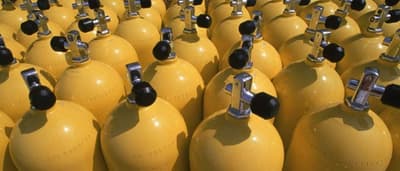
A scuba diver breathing pure oxygen at depths greater than 6 metres of sea water faces a rapidly increasing risk of acute oxygen toxicity [2]. Pure oxygen is mainly used to speed shallow decompression stops at the end of military, commercial, and technical dives [2]. Divers using breathing gases with up to 100% oxygen should have specific training in those gases [3].
Trimix blends oxygen, helium, and nitrogen for deep diving, and its lower oxygen proportion reduces the risk of oxygen toxicity on deep dives [4]. Helium substitutes for some nitrogen to reduce nitrogen narcosis and the work of breathing [4]. Divers adjust the oxygen content for the planned depth so the mix limits toxicity while still supporting life and work [4].
Hyperbaric oxygen therapy, neonatal care, and human spaceflight use protocols to avoid hyperoxia [3]. The US Food and Drug Administration has warned people with heart or lung disease not to use oxygen bars [3]. Oxygen toxicity is managed by reducing exposure to increased oxygen levels, and studies show robust long-term recovery from most types is possible [3].