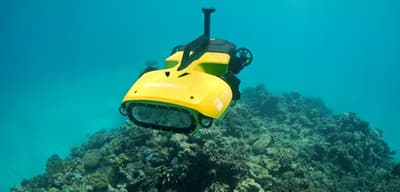
In August 2018, Queensland University of Technology roboticist Matthew Dunbabin brought RangerBot to the Great Barrier Reef, an autonomous underwater vehicle built to identify and kill crown-of-thorns starfish by lethal injection [1]. The deployment formed part of ongoing efforts to control COTS on a reef system that stretches about 2,300 kilometers along the Queensland coast and includes roughly 2,900 individual reefs [1][3].
Adult crown-of-thorns starfish normally measure 25 to 35 centimeters across and can have up to 21 arms [4]. The species, Acanthaster planci, occurs widely in the Indo-Pacific and is named for the venomous, thornlike spines covering its upper surface [4]. It feeds on hard coral polyps, and outbreaks have been a major cause of coral death on the Great Barrier Reef [4][1].
Since 2010, the COTS population has boomed, and the outbreak has plagued the 2,300-kilometer-long Great Barrier Reef [1]. The booms appear to have multiple causes. The sea stars are prolific and fast growing, agricultural runoff boosts food for their larvae, and humans have overfished the few predators willing to eat the venomous pincushions [1]. Research suggests that bringing this sea star explosion under control and preventing future spikes could help reverse coral declines on the reef [1].
Dunbabin developed a computerized system in 2005 that could identify COTS with about 67 percent accuracy [1]. Killing a starfish with the earlier approach would have required injecting a toxic solution into every one of its roughly 20 arms, and missing a few could let the animal survive and regenerate [1]. In 2014 came the discovery that a single shot of a bile derivative could dispatch COTS quickly and completely; bile salts cause tissue damage and a powerful immune response that kills the sea star in less than 20 hours [1].
The torpedo-like COTSbot followed, and advances in robotic vision and artificial intelligence let it recognize COTS 99.4 percent of the time [1]. COTSbot was big, expensive, and deployable only by an expert, so Dunbabin and his team built RangerBot as a cheaper, smaller, more versatile machine that is easier to use [1]. Dunbabin described the goal as intuitive operation like a drone, with a user picking up a tablet, planning a mission, and pressing play [1]. Testing and refining the controls involved potential users, including students at more than a dozen regional high schools [1].
The Great Barrier Reef is the world's largest reef system, composed of roughly 2,900 individual reefs and 940 islands and cays across about 344,400 square kilometers [3]. A 2014 report by the Australian Government's Great Barrier Reef Marine Park Authority identified climate change as the most significant environmental threat, followed by decreased water quality from land-based runoff, coastal development, and fishing [3]. Shallow tropical coral reefs more broadly have declined by 50 percent since 1950 and face excess nutrients, rising ocean heat, acidification, overfishing, and harmful land-use practices [2].
In March 2022, UNESCO launched a monitoring mission to assess pollution, fishing, climate change, and coral bleaching on the Great Barrier Reef [3]. The report concluded that the reef should be included on the list of World Heritage in Danger [3]. In May 2023, Australian Environment Minister Tanya Plibersek promised a combined investment of A$4.4 billion to protect the reef, including no-fishing zones in one third of the site by the end of 2024, a complete gillnet ban by 2027, and water quality targets by 2025 [3].
RangerBot carries the one-shot injection system built around the bile-salt discovery, and its task is to find a starfish, confirm its identity, and deliver the lethal dose [1]. The robot addresses a single predator in a reef facing climate change, runoff, coastal development, and fishing pressure [3]. Its value lies in targeted control of COTS outbreaks while those broader threats remain the focus of reef management [1][3].