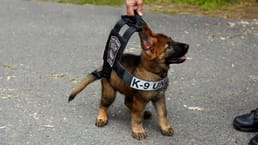
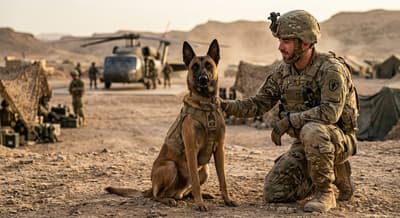
The person at the other end of that leash? Technically the subordinate. In the U.S. military, every working dog is a noncommissioned officer, and by tradition, each one holds a rank one grade higher than the handler walking beside it. A private first class handling a bomb-sniffing Belgian Malinois is, in the eyes of military custom, taking orders from a sergeant with four legs and a very good nose.
"It's a matter of tradition as well as military custom," Air Force Maj. Matthew Kowalski, commander of the 341st Training Squadron at Joint Base San Antonio-Lackland, told HowStuffWorks. "The dog, being a non-commissioned officer, or NCO, would outrank or match in rank to their handler."[1]
The reasoning is elegantly simple. If the dog outranks you, you treat it with respect. You don't cut corners on its care. You don't skip its feeding. You listen when it tells you something is wrong, because in the field, ignoring a senior NCO can get people killed.
"I see it all the time, especially in these young handlers," said Sgt. 1st Class Regina Johnson, operations superintendent at the Military Working Dog School. "They make the mistake of thinking they're actually in charge. You've got to tell them, 'Hold up. That dog has trained 100 students. That dog is trying to tell you something.'"[2]
NCOs With Resumes
This isn't ceremonial fluff. The U.S. has formally trained military working dogs since WWII; today about 2,300 serve worldwide.[3] And some of those four-legged NCOs have service records that would make most soldiers jealous.
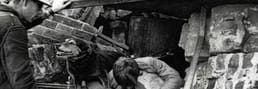
In October 2019, a Belgian Malinois named Conan helped corner ISIS leader Abu Bakr al-Baghdadi during a Special Forces raid. Al-Baghdadi detonated a suicide vest, killing himself and two children. Conan was injured but returned to duty quickly, and was later honored at the White House with a one-of-a-kind medal.[1] Lucca, a Marine Corps search dog, completed over 400 missions across Iraq and Afghanistan before losing a leg to an IED in 2012.[4]
What Happens When They Retire
Before 2000, military working dogs that could no longer serve were euthanized. It didn't matter how many lives they'd saved or how many years they'd given. That changed with the Robby Law, passed by Congress in 2000, which allowed retired military dogs to be adopted by civilians, provided they pass behavioral assessments.[2]
The Snopes fact-checking team investigated the popular claim that the rank tradition specifically exists to prevent abuse, since mistreating a superior NCO carries prison time under Article 91 of the Uniform Code of Military Justice. Their verdict: the outranking tradition is confirmed true, but the anti-abuse origin story remains unverified. What is verified is that harming a military working dog carries up to two years in prison under Article 134 of the UCMJ, regardless of any rank tradition.[5]
"Showing respect to a fellow NCO and deference and respect to an NCO as a lower-ranking service member allows for mutual respect between the partnered team," Kowalski said.[1]
In other words: give the dog a rank, and the handler starts treating it like a partner instead of a tool. It's a hack as old as hierarchy itself. And for the 2,300 four-legged NCOs currently serving around the world, it seems to be working just fine.
Sources
- U.S. Military Dogs Usually Outrank Their Handlers — HowStuffWorks
- Military Working Dogs: Guardians of the Night — U.S. Army
- Military K-9 Unit: Capabilities Forged by Respect — Air Force Special Operations Command
- A Monument to a Great War Dog: Lucca K458 — Animals in War & Peace
- Army Dogs Always Outrank Their Handlers to Prevent Mistreatment? — Snopes