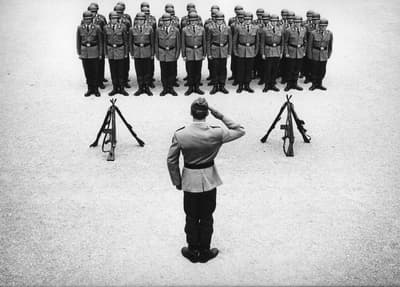
On March 19, 1956, weeks before the first recruits reported for duty, the West German defence ministry issued the Vorgesetztenverordnung, the regulation that defines who may give a soldier an order and who must take it [6]. The same body of rules set out what a military order is: under § 2(2) of the Wehrstrafgesetz, an instruction for a defined behaviour issued by a superior with a claim to obedience [6]. The men who drafted it had the Wehrmacht in front of them as a warning, and they built a system in which obedience attaches to the order's purpose rather than to the man who gives it [6].
The manual makes an order non-binding when it is not "of any use for service" or cannot reasonably be executed [1][7]. An order that denies human dignity to the soldier receiving it or to the person it targets must not be carried out at all [1][7]. That applies to a private in combat and to a general in a headquarters; rank does not turn a service-useless or degrading instruction into a duty [1]. American military law works from a narrower test, permitting refusal only when the order itself is unlawful [1].
Unconditional obedience was the older German norm, reaching back past the founding of the Empire in 1871 [1]. During the First World War the German army executed 48 soldiers for insubordination, and its recruit training was counted among the harshest in Europe [1]. The Treaty of Versailles cut the army to 100,000 men and closed the officer schools [1]. General Hans von Seeckt began rebuilding in secret soon afterwards, with German firms producing banned weapons on Russian soil and German troops training alongside Russian ones [1].
The London Charter of 1945, which established the International Military Tribunal, closed the courtroom escape that had served officers for centuries: superior orders no longer excused a crime, it only reduced the sentence [2]. Nuremberg Principle IV holds that a superior's order does not relieve a person of responsibility under international law where a moral choice was possible [4]. A Holy Roman Empire court rejected Peter von Hagenbach's plea that he had merely followed the Duke of Burgundy's commands and had him beheaded at Breisach on 4 May 1474 [2][8]. In 1921 the Reichsgericht went the other way, acquitting U-boat commander Karl Neumann for sinking the hospital ship Dover Castle because the German Admiralty had authorised it [2].
The Bundeswehr was established in 1955 and declined to treat either the Reichswehr or Hitler's Wehrmacht as its predecessor [3]. Its stated ethos draws on the Prussian reformers Scharnhorst, Gneisenau and Clausewitz and on the officers who tried to kill Hitler, among them Claus von Stauffenberg and Henning von Tresckow [3]. Recruits still make their pledge on 20 July, the anniversary of the 1944 attempt, at the Bendlerblock in Berlin, where the conspirators were shot [3].
In 1953 the Amt Blank, forerunner of the defence ministry, set out Innere Führung, the doctrine of leadership development and civic education built around the "citizen in uniform" [6]. Its authors aimed to cut the power a superior holds over a subordinate and to make the subordinate a participant in the decision [6]. Orders are to state the task and its aim, so a soldier can still reach the objective when circumstances change, a practice known as Auftragstaktik [6]. The result is thinking obedience: compliance is owed to lawful, service-useful orders and refusal to the rest [9].
Command responsibility was codified in the Hague Conventions of 1899 and 1907, partly on the basis of the Lieber Code issued for the Union Army on 24 April 1863 [5]. It was applied at the Leipzig trials of 1921, at Manila against General Tomoyuki Yamashita, and at the court martial of Captain Ernest Medina after the My Lai massacre of 16 March 1968 [5]. German rules put the burden in the same place: a superior is responsible for the consequences of the orders he gives [6].