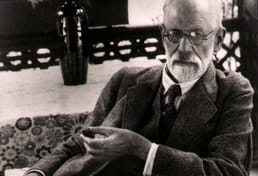

Sigmund Freud was born on 6 May 1856 in Freiberg, a Moravian town in the Austrian Empire that is now Příbor in the Czech Republic [2]. He was the first of eight children born to Ashkenazi Jewish parents, and his father Jakob was a wool merchant [2]. The family was living in a rented room in a locksmith's house when Sigmund arrived, and in 1860 they moved to Vienna [2]. He entered the University of Vienna in 1873 at seventeen and graduated with honors [2].
Freud founded psychoanalysis, a clinical method that treats psychic conflict through dialogue between patient and analyst [2]. He introduced free association, the interpretation of dreams, and the analysis of transference, and his redefinition of sexuality to include infantile stages led him to formulate the Oedipus complex [2]. He built a model of the mind divided into id, ego, and superego [2]. That attention to the id's uncivilized impulses struck the Nazis as an attack on the dignity of the Volk, and psychoanalysts became a specific target alongside Jews in general [1].
In 1933 mobs of Nazi sympathizers burned Freud's books [1]. The chant they used, recorded by The Atlantic, consigned the writings of Sigmund Freud to the flames on behalf of the nobility of the human soul [1]. Freud was 77 that year and still living in Vienna.
Austria was annexed into Nazi Germany in 1938 and became a sub-national division of the Reich [3]. The annexation came a year before the outbreak of World War II [3]. After German forces took Vienna, the Nazis seized Freud's money, property, and publishing house [1]. Vienna was the capital and most populous city of Austria, and Freud had lived there for nearly eight decades [3][2].
By 1938 Freud was in his early eighties and, in TIME's words, tortured by advanced cancer of the jaw [1]. A nephew of his, a publicist in Manhattan, urged him to take refuge in the United States [1]. Freud turned the offer down. America is gigantic, he reportedly said, but a gigantic mistake [1].
Princess Marie Bonaparte, Napoleon's great-granddaughter and one of Freud's patients, paid what amounted to a ransom to secure his exit visas [1]. She also brokered a deal that allowed him to salvage his library, his large sculpture collection, and his celebrated couch [1]. The destination she arranged was London, not New York [1].
The Nazis let Freud leave Austria on condition that he sign a statement swearing they had treated him well [1]. He signed it and appended a line of his own: I can most highly recommend the Gestapo to everyone [1].
In London, Freud lived an exile that TIME describes as idyllic despite his near-constant pain [1]. W. H. Auden's 1940 tribute described him as no more a person now but a whole climate of opinion under whom we conduct our different lives [2]. Psychoanalysis remains influential within psychology, psychiatry, and psychotherapy, and it continues to generate debate about its therapeutic efficacy and scientific status [2]. Freud died in London on 23 September 1939 [2].