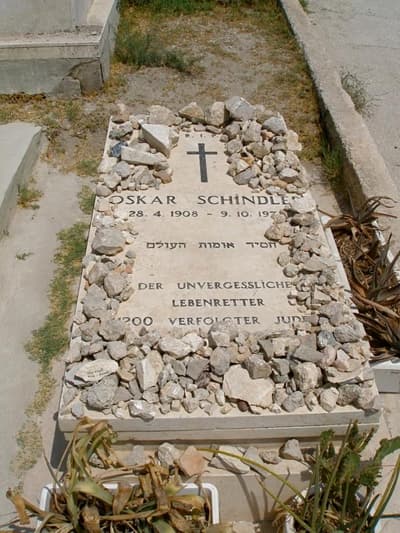
A small Catholic cemetery on the southern slope of Mount Zion holds the grave of Oskar Schindler, and visitors stack small stones on the marker in the Jewish custom of honouring the dead [1][6]. The hill stands just outside the walls of Jerusalem's Old City to the south, and the name Mount Zion shifted across three locations over the centuries before settling on the Western Hill [3]. The inscription on the grave is carved in Hebrew, German and English [6].
Schindler died on 9 October 1974 in Hildesheim, Germany, and was buried on Mount Zion at his own request [2][6]. He is the only former member of the Nazi Party to be honoured with burial in Jerusalem [2][6]. Jews, Christians and people of no religious faith visit the grave [1].
He was born on 28 April 1908 in Zwittau, Moravia, into a Sudeten German family [2]. He joined the Abwehr, Nazi Germany's military intelligence service, in 1936, gathered information on railways and troop movements, and was arrested for espionage by the Czechoslovak government before being released under the Munich Agreement in 1938 [2]. He joined the Nazi Party in 1939 and that year acquired an enamelware factory in Kraków, which at its 1944 peak employed about 1,750 workers, 1,000 of them Jews [2].
In July 1944, with Germany losing the war, the SS began closing the easternmost concentration camps and deporting prisoners westward [2]. Schindler persuaded Amon Göth, commandant of the Kraków-Płaszów camp, to let him move his factory to Brněnec in the Protectorate of Bohemia and Moravia [2]. Göth's secretary Mietek Pemper compiled and typed the list of 1,200 Jews who travelled to Brünnlitz in October 1944, working from names supplied by Marcel Goldberg, an officer of the Jewish Ghetto Police [2]. Schindler kept bribing SS officials until May 1945 and spent his entire fortune doing it [2].
Two lists of 1,098 prisoners, made by camp administrators at Brünnlitz on 18 April 1945, survive at Yad Vashem: one names 297 women, the other 801 men [4]. That figure of 1,098 is the count on those particular sheets, while the number usually credited to Schindler is about 1,200 [2][4]. In 2012 an estimated 8,500 descendants of the Schindlerjuden were living in the United States, Israel and other countries [4].
After the war Schindler lived in West Germany on support from Jewish relief organisations, then moved with his wife Emilie to Argentina to farm [2]. They went bankrupt in 1958, he left his wife and returned to Germany, where his business ventures failed and he depended on help from the people he had saved [2]. He planted a tree on the Avenue of the Righteous at Yad Vashem in 1962, and in 1993 Yad Vashem named Oskar and Emilie Schindler Righteous Among the Nations [2][6].
Thomas Keneally's 1982 novel Schindler's Ark brought the story to a wide readership, and Steven Spielberg's 1993 adaptation Schindler's List carried it further [2][5]. The film earned $322.2 million worldwide on a $22 million budget and won seven Academy Awards, including Best Picture [5]. The Library of Congress added it to the National Film Registry in 2004 [5]. Poldek Pfefferberg, one of the Schindlerjuden, had pressed Keneally to write the book and Spielberg to make the film [4].