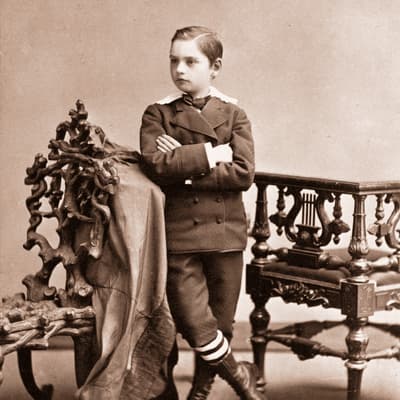
By the middle of March 1884, the staff at the Bristol Hotel in Florence had straw scattered on the street outside to deaden the noise. Inside a darkened room, doctors wrapped a fifteen-year-old boy in ice-cold wet sheets to bring down a fever, a treatment he begged them to skip, and nuns sat with him through the night. Leland Stanford Junior died there on March 13, two months before his sixteenth birthday.[1]
He had been traveling through Europe with his parents, and the winter had started well. The family spent Christmas of 1883 in Vienna, then went on to Constantinople, where the sultan wanted his father’s advice on building a Turkish railroad. On a rough day on the Bosporus, the boy was allowed to steer the party’s steamboat and stood at the wheel from morning until evening with spray coming over the deck. Bertha Berner, Jane Stanford’s secretary, remembered him as greatly excited and very happy. That evening his mother thought he looked pale.[1]
Athens came next, in January 1884, with snow knee-deep. He insisted on visiting the ancient temples and on meeting Heinrich Schliemann, who had recently unearthed the site of Troy. By mid-February the family was moving back toward Italy, and neither mother nor son was well. Rome did not suit him. In Florence the air was supposed to be better.[1]
Leland and Jane Stanford had been married nearly eighteen years without children when he was born in Sacramento on May 14, 1868. They announced him at a dinner party by carrying him around the table on a silver platter, on a bed of blossoms, for the guests to admire. He grew up with a pony, a toy train that ran on four hundred feet of track, and a small museum on the third floor of the family’s San Francisco mansion for the curiosities he brought home.[1]
An earlier European tour, when he was twelve, left him asking how macaroni was made and how glass was blown, down to the wages and the hours. On the second tour he spent afternoons in the Egyptian wing of the Louvre, copying hieroglyphics with the help of an Egyptologist, and worked the antiquities dealers with small sums he had to account for. His tutor liked to tell how the boy would hand a piece back and remark quietly that it was an imitation.[1]
After the funeral, the Stanfords buried their son in a small mausoleum near the house on their Palo Alto farm. Leland Stanford is said to have dreamed of the boy urging his parents to keep living for the good of humanity. Within a year they signed a grant founding and endowing the Leland Stanford Junior University, with the stated aim of qualifying students for personal success and direct usefulness in life, the same goal they had set for their son. Leland Stanford told his wife that the children of California would be their children.[1][2][3]
The institution opened on October 1, 1891, on the family’s 8,180-acre stock farm, with fifteen faculty members and 555 students, forty more than Berkeley enrolled that year. The founding grant made it coeducational, nonsectarian, and tuition-free, which lasted until 1920. Its legal name has never changed. The mausoleum where the boy was first buried still stands on the campus that grew around it, and his name is still the university’s official title.[2][3]