In 1906, Ludwig Pollak saw a marble arm in Rome and recognized it as the missing piece of an argument that had been going on for four centuries. The fragment had been found only meters from the vineyard where the Laocoön Group had come out of the ground in 1506.[1]
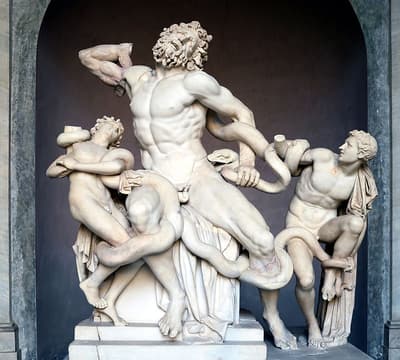
The Laocoön Group was unearthed in Rome with its central figure’s right arm missing. Michelangelo argued the arm had bent back over Laocoön’s shoulder, and the original arm found in 1906 proved remarkably close to that reading.
On 14 January 1506, workers digging in a vineyard on Rome’s Oppian Hill struck marble near the ruins associated with Nero’s Domus Aurea and the Baths of Titus.[2] As the soil came away, the figure was not a serene god or a clean imperial portrait. It was a tangle of bodies and serpents: the Trojan priest Laocoön and his two sons being attacked by sea snakes.[3]
The sculpture was nearly life-sized and more than two meters high, carved in marble, with Laocoön twisting at the center while serpents coil through the bodies of his sons.[3] It was put on public display in the Vatican Museums, where it remains today.[3] Renaissance viewers had another reason to crowd around it. The work was very likely the same sculpture praised by Pliny the Elder, who attributed it to Greek sculptors and admired it in unusually high terms.[3]
The Missing Limb
Laocoön did not return from the earth intact. His right arm was gone. So were part of one child’s hand, the right arm of the other child, and sections of the snakes. The older son was detached from the other two figures.[3] For artists, the missing arm was a question of drama. A restored limb would decide how the whole body seemed to suffer.
An arm reaching outward made Laocoön look more heroic, still pushing against the serpents and the gods. A bent arm pulled back over the shoulder made the figure tighter, more trapped, more desperate. Michelangelo favored the second solution, arguing that the missing right arms had originally been bent back over the shoulder.[3]
Others preferred a grander gesture. According to Vasari, around 1510 Bramante, the pope’s architect, held an informal contest among sculptors to make replacement arms for the Laocoön.[3] The accepted restoration favored the extended arm, thrust outward in a heroic pose.[3] Michelangelo’s bent-arm interpretation lost, and for centuries viewers saw the ancient priest reaching in the wrong direction.
The Arm Comes Back
Pollak’s 1906 discovery reopened the old decision. The marble arm he identified was later accepted as belonging to the ancient group, and its cramped, bent position matched Michelangelo’s proposal far more closely than the extended pose chosen by earlier restorers.[1]
The Vatican account gives the fragment a second, darker history. Pollak, the Jewish art dealer credited with recognizing the arm, later faced fascist and Nazi persecution in Rome. Vatican News reports that he refused protection from the Vatican and was eventually deported and killed at Auschwitz, despite efforts by Bartolomeo Nogara, then director of the pontifical galleries, to save him.[1]
The recovered arm turned a restoration dispute into something smaller and stranger than artistic victory. The artist who lost the Renaissance argument had read the ancient body more accurately than the winners. Today, the Laocoön still twists under the serpents in the Vatican Museums, his right arm pulled back toward his shoulder, as if the marble itself is trying to wrench free.