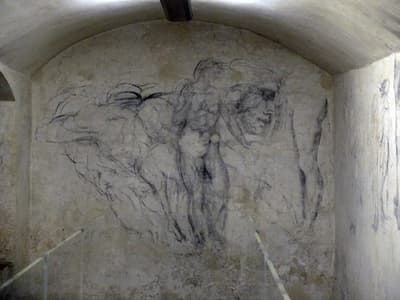
Paolo Dal Poggetto was looking for an exit, not a masterpiece. In 1975, the director of Florence’s Medici Chapels Museum followed a clue from custodians to a trapdoor hidden beneath a wardrobe. It opened onto a narrow underground room, about 33 feet by 10 feet, too cramped and dead-ended to solve his visitor-flow problem. Then the plaster began to come off the walls.[2][3]
Under the Medici Chapels in Florence, a sealed storage room was found covered in charcoal and chalk drawings that some scholars attribute to Michelangelo, who may have hidden there in 1530 after backing the wrong side in a dangerous political fight.
The chamber had not been preserved as a sacred relic. It had been used to store coal until 1955, then sealed away beneath the Medici complex at San Lorenzo.[3][5] Under layers of plaster, Dal Poggetto found dozens of quick figures and fragments: faces, nudes, arms, legs, and bodies layered across the small room’s walls.[3]
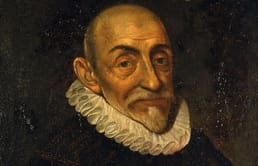
Dal Poggetto believed he recognized the hand behind them. He argued that Michelangelo Buonarroti had made the marks while hiding in 1530, when Florence’s politics had turned dangerous for people who had supported the defeated republican government.[3][5]
The Wrong Patron at the Wrong Moment
Michelangelo’s trouble began with a family that had once helped him rise. The Medici were major Florentine patrons, and Michelangelo had worked for them, including on the New Sacristy, the family’s funerary chapel at San Lorenzo.[4][6] But after the Medici were expelled from Florence in 1527, he sided with the republic that replaced them and helped fortify the city against their return.[3][4]
In 1530, the Medici came back. Pope Clement VII, born Giulio de’ Medici, was said to have ordered or threatened severe punishment against Michelangelo for his role in the revolt.[3][5] The artist disappeared. Several modern accounts place him for roughly two months in the cramped, windowless room below the chapel, though the older legend often stretches the hiding to several months.[3][4][5]
On the walls, some drawings seem to look backward through Michelangelo’s own memory. A nude near the entrance has been compared by some experts to his Resurrection of Christ. A sketch of legs has been linked to forms on a tomb in the chapel. Other marks have been connected, more cautiously, to The Fall of Phaeton, the lost Leda and the Swan, and even the arm of David.[3][5]
A Room That Still Refuses to Confess
The walls carry no signature. Dal Poggetto was convinced the drawings were Michelangelo’s, but scholars have continued to debate whether all, some, or none can be securely attributed to him.[3][4] The strongest version of the story is also the hardest to prove: a famous artist, newly vulnerable, using charcoal and chalk in a hidden room below the chapel of the family he had crossed.
For decades, visitors could not descend and judge for themselves. The room officially opened to the public for the first time in 2023, with strict limits: four people at a time, 15 minutes inside, and no more than 100 visitors per week.[3][4] Between visits, the chamber is kept dark to protect the fragile charcoal and chalk from light exposure.[3]
Paola D’Agostino, director of the Bargello Museums, has described the first moments inside as nearly speechless, as visitors wait for their eyes to adjust and the layered drawings begin to appear.[3] The room still answers slowly: a trapdoor under a wardrobe, a coal chamber under a chapel, and figures surfacing from the dark.
Sources
- Atlas Obscura, “Michelangelo’s Hidden Drawings”
- HISTORY, “Inside Michelangelo’s Secret Room?”
- Smithsonian Magazine, “Did Michelangelo Sketch These Drawings in a Secret Room Below a Florence Chapel?”
- The Geographical Cure, “Michelangelo’s Secret Drawings: The Hidden Room Beneath Florence’s Medici Chapels”
- The Guardian, “Michelangelo’s secret sketches under church in Florence open to public”
- Artnet News, “Why Michelangelo Spent Months Hiding From the Pope”