A prior at Santa Maria delle Grazie had a wall-sized problem. Leonardo da Vinci was working too slowly on The Last Supper, and the complaint was practical enough: the refectory mural was not a sketchbook page, and the convent had to live with the unfinished work. Leonardo’s reply, according to the famous anecdote, was sharper than an excuse. If the prior kept pressing him, Leonardo could use his face for Judas.[1]
Leonardo da Vinci’s procrastination became part of the legend of The Last Supper: when a prior complained about the slow progress, Leonardo reportedly threatened to make him the model for Judas, and the complaints soon stopped.[1]
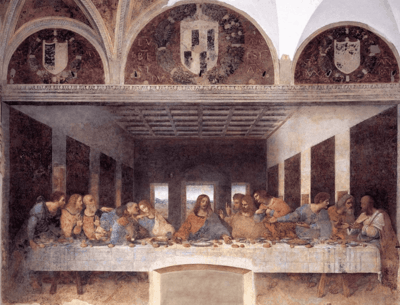
Judas mattered because the painting turns on betrayal. The Last Supper shows the charged moment after Jesus tells the apostles that one of them will betray him, with shock passing across the table through faces, hands, and bodies.[1] To be made Judas in that scene was not merely to be included. It meant becoming the visible face of treachery.
Leonardo was the sort of artist who could make a prior anxious. He is still treated as one of the classic examples of a Renaissance man, a person of wide ability in both the arts and sciences. In Leonardo’s case, that reputation includes not only painting, but science, philosophy, engineering, and mathematics.[2] Art Facts also describes him as famous for procrastination and distraction, which makes the prior’s impatience easier to imagine.[1]
A Wall Too Big To Ignore
The original Last Supper was not a canvas waiting to be moved into a gallery. It was a mural made for its setting, and it was enormous, about 460 centimeters by 880 centimeters, or 180 inches by 350 inches.[1] Reproductions make it familiar. The real work was architectural, broad enough to dominate a room.
That scale gave delay a public quality. A slow painter working on a small panel can disappear into a studio. A slow painter covering a convent wall becomes part of daily life. The prior was not complaining about an abstract artistic temperament. He was looking at a large unfinished surface in a religious house.
Leonardo also chose a difficult path. Instead of using the standard fresco technique, he used an experimental method.[1] The decision became part of the painting’s long trouble. Not much of the original remains, the location itself was not ideal, and later restoration attempts often failed.[1] The work that now seems inevitable was physically vulnerable from the beginning.
The Face No One Wanted
Inside the painting, Judas is marked by more than his name. He is shown as the betrayer, and Art Facts identifies him tipping over the salt cellar.[1] Around him, the apostles react in groups. Peter appears angry, and Thomas raises the gesture associated with his later nickname, “Doubting Thomas.”[1] The scene has lasted because it feels like a room caught in the first seconds after terrible news.
The anecdote has lasted for a different reason. Leonardo’s threat turned a workplace argument into a question of memory. The prior could keep complaining, but the punishment Leonardo suggested was not a fine or a quarrel. It was a likeness, fixed on the wall beside Jesus at the moment of betrayal.
Time punished the painting in ways no prior could have foreseen. Napoleon’s troops later treated it carelessly, and the mural was severely damaged during World War II.[1] Modern viewers know The Last Supper as a survivor, restored, copied, guarded, and endlessly discussed.
The prior wanted speed. Leonardo answered by gesturing toward the empty place where Judas’s face could still be decided. Centuries later, the wall remains damaged and famous, while the old complaint survives as a strangely effective studio threat: hurry me, and you may sit forever with the betrayer.