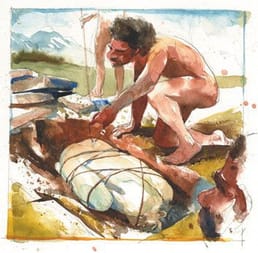
On 12 September 1940, a dog disappeared into a foxhole on the hill of Lascaux. The boys with him were not hunting for prehistory. They were trying to deal with a small emergency in the ground. Marcel Ravidat widened the opening, then slid down first into the darkness, with three friends following after him.[1][3]
The Lascaux cave entrance was discovered in 1940 near Montignac, France, after Marcel Ravidat’s dog, Robot, fell into a hole. When Ravidat and his friends explored the opening, they found Paleolithic cave walls covered with painted animals.
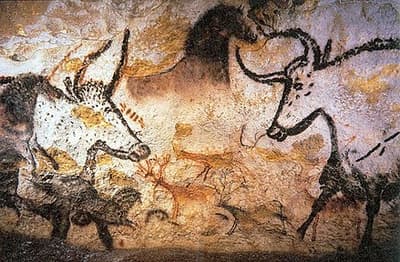
At the bottom, the foxhole became something larger. The boys made a makeshift lamp so they could see where they were going, and in the Axial Gallery the light picked up figures on the walls: animals, large and deliberate, laid across stone by people who had been gone for thousands of years.[3]
The next day, the boys returned better prepared and pushed farther into the cave.[3] The place they had entered near Montignac, in the Dordogne region of southwestern France, is now known as Lascaux, or Grotte de Lascaux, a network of caves whose walls and ceilings hold more than 600 paintings.[1] Alongside those painted figures are roughly 1,400 engravings of a similar order.[3]
A Dog, A Hole, And A Gallery Of Animals
Horses appear again and again at Lascaux. There are also deer, aurochs, ibex, bison, and even felines, the animals arranged in compositions that still feel charged when described in plain inventory.[3] The paintings are usually dated to the Upper Paleolithic, with estimates commonly placing them roughly 17,000 to 22,000 years ago, though dating and interpretation remain debated.[1][3]
The first moment was almost absurdly small for what followed. No official expedition had arrived on the hill with equipment. No museum team was mapping a chamber. A dog had fallen into a hole, boys had widened the entrance, and a teenager had gone down first.[1][3] Then the cave gave them animals.
After the boys told their teacher, the adventure moved into the slower world of excavation and study.[3] By 1948, Lascaux had been prepared for public visitors.[3] It became one of the best-known decorated caves in a region already rich in prehistoric sites, famous for the scale and force of its images as much as for the accident of its rediscovery.[2][3]
Why Lascaux Still Feels Alive
The French archaeology site describes the 1940 discovery as the beginning of a new era in knowledge of prehistoric art and human origins.[2] The reason is not hard to see. Lascaux does not come to us only as tools, bones, or traces interpreted from a distance. It comes as images made to be seen, animals moving across rock surfaces in chambers that once had to be entered by lamplight.[3]
The meaning of those images remains unsettled. A common interpretation gives them a ritual or spiritual dimension, but no single explanation has closed the question.[3] The safer claim is also the more interesting one: skilled people living in the region made them, and the work appears to reflect many hands or many generations rather than a single moment of decoration.[1][3]
In 1979, Lascaux was added to the UNESCO World Heritage list as part of the Prehistoric Sites and Decorated Caves of the Vézère Valley.[1] Today, visitors are directed to replicas, including Lascaux IV, which its official site describes as a complete and exact replica of the original cave at the International Centre of Parietal Art.[4]
The modern visit is carefully managed, lit, and interpreted. The beginning was not. Before the visitor center, before the replicas, before Lascaux became a world heritage name, there was a hillside near Montignac, a hole in the ground, a dog named Robot, and a boy lowering himself toward painted animals in the dark.