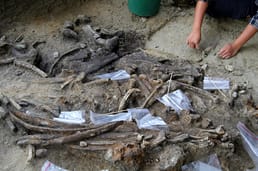
Bruno Maureille stopped at a limestone ledge in southwest France and pointed to something pale and narrow, like a snapped pencil caught in the earth. It was a butchered reindeer bone. Nearby sat a stone tool shaped roughly like a hand-size D, probably used to slice meat from bone 50,000 years ago.[1]
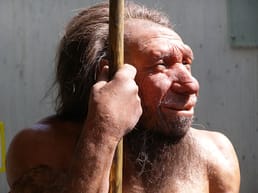
Neanderthals were once cast as crude, dim-witted cavemen, but finds from France, Siberia, Spain and elsewhere now show a capable human relative: skilled toolmakers, organized hunters, fire users, social beings and possible artists whose intelligence was much closer to ours than old stereotypes allowed.
Les Pradelles, about 280 miles southwest of Paris, has yielded Neanderthal remains, animal bones and lithic tools from what researchers interpret as a butchery site.[1] The old caricature depended on a blunt assumption: if Neanderthals disappeared, they must have been inferior. The bones and tools have made that harder to defend.
Fred H. Smith, a physical anthropologist at Loyola University Chicago, told Smithsonian that early European anthropologists imagined Neanderthals as “primitive humans” and even “subhumans,” scavengers with crude tools and no language or symbolic thought.[1] Researchers now view them, Smith said, as highly intelligent and able to adapt to many ecological zones.[1]
The Tool Was a Clue
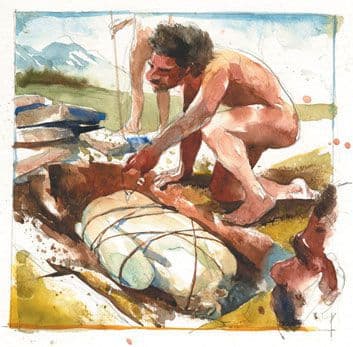
A hand-size stone edge from a hunting camp carries a kind of biography. Neanderthals made sophisticated tools, used fire, wore clothing and built shelters.[3] They also hunted large animals in organized groups, which required cooperation, timing and shared knowledge rather than random violence.[3]
The Levallois method, one of the best-known Neanderthal stoneworking techniques, required a maker to shape a stone core in a planned sequence before striking off a useful flake.[4] Other evidence points to controlled fire, cooked food and plant-based adhesives used to bind tools, a practical form of prehistoric chemistry.[5]
At Chagyrskaya Cave in southern Siberia’s Altai Mountains, the evidence narrows from species to household. The cave opened above a green river valley where bison, horses and reindeer could be spotted.[2] Excavations there produced about 90,000 stone tools, 300,000 bone fragments and remains from at least 11 genetically connected Neanderthals, including a father, his teenage daughter and cousins.[2] They were a family group in a chosen place, living by skill, memory and shared labor.
The Social Animal in the Cave
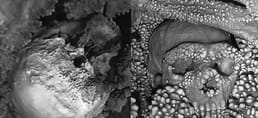
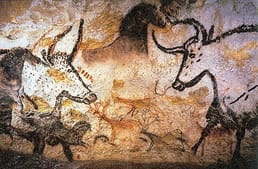
Some Neanderthal sites point beyond hunting. Evidence suggests they may have cared for the sick and buried their dead.[1] Research summaries also describe communities that made ornaments and may have created cave art.[3] In Spain, abstract designs on stalagmites have been dated to more than 60,000 years ago, and other finds include eagle talons and seashells fashioned into personal ornaments.[5]
The correction has limits. Neanderthals had bodies different from modern humans, including stockier builds, large noses and prominent brows.[4] Their disappearance around 40,000 years ago remains under study, with possible explanations including competition with Homo sapiens, climate change, population decline and absorption through interbreeding.[3] Extinction, though, is not an intelligence test.
The hunched brute began partly with a damaged skeleton. A 1911 reconstruction by Marcellin Boule helped fix the stooped, hairy image in the public mind, but it was based on remains from an elderly individual whose bones showed deformities and spinal curvature.[4] A sick old body became a species’ posture.
Back in the limestone pit at Les Pradelles, the rebuttal is small enough to hold in the hand: a snapped-looking reindeer bone, a worked stone edge, and the remains of a meal processed by hands that knew exactly what they were doing.[1]
Sources
- Smithsonian Magazine, “Rethinking Neanderthals”
- Newsweek, “Neanderthals Were Smart, Sophisticated, Creative and Misunderstood”
- Smithsonian Magazine, “Neanderthals: Our Misunderstood Prehistoric Relatives”
- TheCollector, “Neanderthal Nonsense: Debunking Myths About Our Ancient Cousins”
- Living DNA, “Debunking Neanderthal Myths: Setting the Record Straight on Our Ancient Cousins”