In early October 1993, researchers exploring Lamalunga cave near Altamura in southern Italy came across human bones, including a skull [6]. They alerted anthropologists Eligio Vacca and Vittorio Pesce Delfino at the University of Bari Aldo Moro, who arrived the following evening [6]. The cave sits in the karst landscape of Puglia, where water draining through bedrock opens sinkholes, springs and caverns [6].
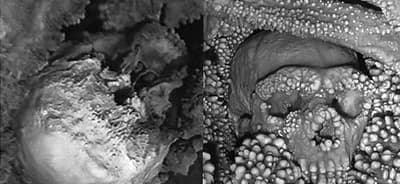
The skull was upside down, wedged into the cave wall [4]. Every bone was at least partly covered by, or embedded in, calcareous concretion, and some carried a shell of calcite of varying thickness [6]. Nodules of the material, known as cave popcorn or coralloids, crusted the cranium and gave the specimen its gnarly appearance [4][6].
Calcite dissolved in rainwater accumulates on whatever surface the water passes over, and at Lamalunga that surface included a human skull [2]. Lee-Gray Boze, a physical scientist at the United States Geological Survey, told How Stuff Works that popcorn usually occurs in wet areas of a cave where water flows across the surface, and that dripping water can produce it in a radius around drip sites [2]. The skeleton lay concentrated in a small area rather than scattered by water, which suggests it collapsed where it fell once the body had decomposed [2].
The man most likely fell into the sinkhole and became stuck, then died of thirst or starvation [1][2]. Animal bones elsewhere in the cave's galleries had been dispersed by water, but his had not [2]. Sheltered from weather and predators, the remains stayed in excellent condition [1].
For more than twenty years nobody touched the skeleton, because excavating it risked irreparable damage [1][2]. Researchers worked from on-site observation and photographs, and experts could not agree on its age or even its species [1][2]. Then in 2015 a team retrieved a fragment of the right shoulder blade for DNA analysis [1][5]. Researchers at Newcastle University, working with Sapienza University of Rome and the University of Florence, found that the DNA matched other Neanderthal remains [5].
Uranium-thorium dating of the calcite put its formation between 170,000 and 130,000 years ago, during the next-to-last Quaternary glaciation [1]. Other published ranges for the individual run from 128,000 to 187,000 years [2][3], and from 130,000 to 172,000 years [4]. The DNA identified a Neanderthal male who was about 35 when he died [1]. Later study found a fully adult individual with common dental pathologies and several missing teeth [4].
In 2015 David Caramelli, a professor of anthropology at the University of Florence, worked with a colleague to build a model of the man's face [1]. They used laser scanning and photogrammetry, a method of taking precise measurements from photographs, and combined the results with the DNA analysis [1]. The Dutch paleo-artists Alfons and Adrie Kennis turned the data into a hyper-realistic reconstruction showing a short, stocky man with a heavy brow, a large nose and an elongated skull [1]. Some of the skull traits were archaic even for the period, hinting that he might bridge Neanderthals and the earlier Homo heidelbergensis [1].
A 2024 study in Quaternary Science Reviews reported four years of work inside the cave using portable X-ray machines, high-resolution endoscopic cameras and miniature laser scanners small enough to pass through openings in the rock [4]. The bones are not fully fossilised, probably because cave temperatures vary widely and fresh air blows in, which leaves them fragile [6]. Giorgio Manzi, one of the palaeoanthropologists leading the research, called the skeleton an incredible treasure for the Alta Murgia territory [5]. It still lies partly embedded in speleothems and extensively covered by coralloid concretions, and getting it out intact remains an unsolved problem [4][6].