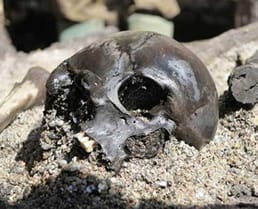
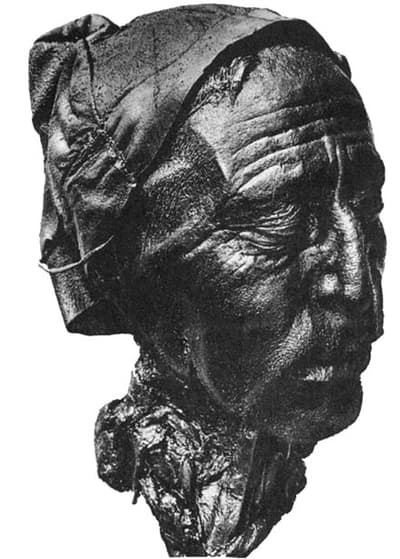
Two brothers were cutting peat in Bjaeldskov bog, west of Silkeborg, in May 1950 when the peat gave them a face. Not a skull or a scatter of bones, but a man with skin, closed eyes, and features clear enough that the police were called to investigate what looked like a recent murder.[1]
Tollund Man is one of the most famous bog bodies ever found: an Iron Age man preserved for more than 2,000 years with recognizable features, well-preserved organs, a noose around his neck, and traces of a final porridge meal made from many seeds and grains.
The body had not been waiting for days. Scientific dating places Tollund Man’s death around 405 to 384 BC, in the Pre-Roman Iron Age on the Jutland peninsula.[1] He was about 40 years old when he died and measured roughly 1.61 metres, or 5 feet 3 inches, though preservation in the bog may have shrunk him after death.[1]
Peat did the work that ordinary soil would not. Acid in the bog, combined with the lack of oxygen beneath the surface, helped preserve delicate soft tissue for more than two millennia.[4] Examinations and X-rays found that his head was undamaged and that his heart, lungs, and liver were well preserved.[4] The result was not the dry, bandaged figure most people picture when they hear the word mummy. Tollund Man still looked like a person.
A Body That Looked Asleep
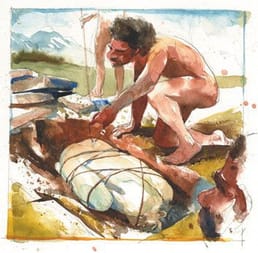
A leather cap was on his head, a wide belt was around his waist, and a braided leather rope was still tightened around his neck.[2] His eyes and mouth had been closed, and his body had been placed in the bog in a sleeping position.[2] Those details have kept one question open for decades: whether he was killed as a ritual sacrifice, punished as a criminal, or put to death for reasons that no longer fit our categories. The cause of death is clearer than the motive.[1]
The rope left marks beneath his chin and along the sides of his neck.[4] A later re-examination found more evidence consistent with hanging, including a distended tongue.[4] Yet the body did not present a long catalogue of injuries. Accounts of the remains emphasize the hanging itself, not wounds that would make the death easy to read as an ordinary assault.[2]
The bog had produced another body before him. Twelve years earlier, Elling Woman had been found in the same bog.[1] For peat cutters, the landscape was a place of work. For archaeologists, it became something stranger: an archive that could hold skin, rope, moss, and the contents of a stomach long after names and voices had disappeared.
The Meal Still Inside Him
Scientists examined Tollund Man’s stomach and intestines and found the remains of his last meal.[4] It was a porridge made from cultivated and wild plants, including seeds and grains.[4] Later descriptions identify about 40 kinds of seeds and grains in that meal, eaten 12 to 24 hours before he died.[2]
A meal is a small survival. Someone gathered or stored those ingredients. Someone cooked them. Tollund Man ate, digested, and then entered the final day that the bog would preserve with unnerving precision.
Today, visitors can still go near the finding place by Bølling Sø, south of Silkeborg. From the car park, the route is about 800 metres over hilly ground.[3] It is a modest walk to a place where time folds in on itself: peat underfoot, a quiet path, and the remembered face of a man once taken for the dead of yesterday.