The first cod did not look clever. It looked stuck. In a research tank southwest of Bergen, Norway, a colored bead near its dorsal fin caught on the pulley of a self-feeder. The string tightened. The fish bolted, shook itself loose, and dry food fell into the water.[1]
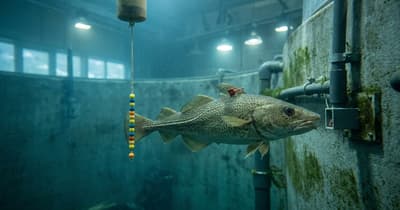
At the Austevoll research station, four tanks held 56 Atlantic cod under steady laboratory light. Each fish carried an external tag so the researchers could tell who was doing what. The feeding machine was built for a mouth: bite the bead at the end of the pull string, swim forward, and 0.8 grams of food dropped about 60 centimeters away.[1]
On the videos, most successful fish used the feeder exactly as the device expected. Three fish found the loophole by mistake. They accidentally snagged their ID tags into the trigger pulley, and the machine released food anyway. Over time, scientists observed the same fish stop treating the feeder as a mouth problem and start using their ID tags to activate it instead.[1]
After enough repetitions, the tag move had its own choreography in the water. The cod edged into position, hooked the tag bead on the trigger, stretched the line, turned free, and headed for the food. Their trips to the feeding area got faster after the switch. Two of the fish even settled into a regular rotation direction, one small signature in the tank.[1]
By day 11, Fish 1 had stopped using its mouth on the feeder entirely. It logged 51 mouth activations and 422 tag activations. Fish 2 finished with 195 tag activations. Fish 3 finished with 37 tag activations, fewer than the others but still enough for the researchers to describe the same learned maneuver. The paper called the behavior novel, goal directed, and possibly one of the few observed cases of innovation and tool use in fish.[1]
For a scientist, an ID tag is a convenience: a little bead that turns an animal into a record. The cod made the label less obedient. A marker added for human bookkeeping became part of the fish's own problem solving, a handle it could catch, pull, release, and cash in for food.[1]
In a later review, Culum Brown gathered evidence that fish learn, remember, track social information, and adjust to new problems more flexibly than the old jokes allow.[2] California sheephead wrasses make a rougher version of the point when they use rocks as anvils to break open prey.[3]
The cod needed no rock. They had a colored bead on their backs, a string in front of them, and dinner released by a tug. What began as a nuisance became a routine. For a moment in cold lab water, the tag stopped being a note to the humans and became a tool for the fish wearing it.
Sources
- Millot et al., "Innovative behaviour in fish: Atlantic cod can learn to use an external tag to manipulate a self-feeder," Animal Cognition
- Culum Brown, "Fish intelligence, sentience and ethics," Animal Cognition
- R. P. Dunn, "Tool use by a temperate wrasse, California sheephead," Journal of Fish Biology