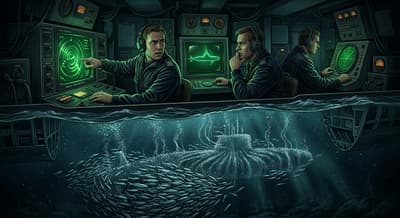
For years, Sweden listened to what sounded like enemy submarines slipping through its waters. The navy heard the signals, worried about Soviet intrusions, and spent real time and money chasing them. Then scientists took a closer listen and found something almost comic: the "submarines" were schools of herring releasing bubbles.[1][2][4]
The noise was not some vague underwater burble. Swedish researchers Magnus Wahlberg and Håkan Westerberg studied herring gas release and found that the fish produced a distinctive sound they called a "pulsed chirp," a rapid series of pulses created when air was expelled through the anal opening from the swim bladder system.[4] Another team studying Pacific and Atlantic herring recorded related sounds they named Fast Repetitive Ticks, or FRTs, broadband pulse trains that often appeared after dark and lasted up to several seconds.[3]
The truly strange part is that this was probably not digestion in the way you are imagining it. As The Guardian noted in its summary of the research, gas chromatography suggested the bubbles were air the fish had gulped at the surface, not classic intestinal flatulence.[1] Herring use that air to manage their swim bladders, and they can vent it through a duct connected to the gut and anal opening.[3][4] So yes, "herring farts" is the headline version, but the biology is weirder and more elegant than that.
Once you know this, the Cold War panic starts to look like a perfect storm of context and acoustics. Sweden had real reasons to be jumpy after Soviet submarine incidents in the Baltic, so unexplained underwater noises landed in a very nervous political moment.[2] What the navy needed was not more suspicion. It needed a biologist with a hydrophone. By the mid-1990s, researchers showed that herring bubble sounds matched the mystery signals closely enough to help deflate years of submarine anxiety.[1][2][4]
And there is one more twist. Wilson and his co-authors found that herring produced more of these sounds at night and that sound output increased with crowd size, which hints at a social function, perhaps helping scattered fish keep track of the school in darkness.[3] A noise once treated like a military threat may actually have been a fish version of "still here, stay close."
That is what makes the story stick. It is funny, but it is also a reminder that fear and bad measurement can make ordinary things look menacing. Sometimes the monster on sonar really is a submarine. Sometimes it is dinner, making tiny bubbles in the dark.[1][2][3][4]