
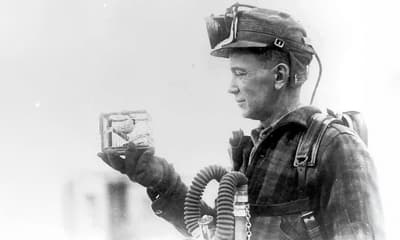
The phrase "canary in the coal mine" sounds abstract now, the kind of thing people say in boardrooms. Underground, it was literal. Miners really did carry canaries to detect carbon monoxide, and in some cases they carried tiny oxygen chambers so the birds could be revived after exposure.[1]
That detail changes the picture. The usual version is brutally simple: bird dies, men live. But the real system was stranger and slightly more humane. Canaries were used because they reacted to toxic gas faster than people did. If a bird stopped singing, showed distress, or collapsed, miners knew they had only minutes to get out.[1][2][3][5]
The practice grew out of catastrophe. After the 1896 Tylorstown colliery explosion in Wales, physiologist John Scott Haldane investigated the deaths and helped show that carbon monoxide was a major killer after mine explosions and fires, not just the blast itself.[3][4] That insight pushed mine safety in a new direction. Small animals were eventually taken underground because they could warn of poisonous gas before humans noticed anything was wrong.[3][4]
By 1911, canaries had become standard equipment in British pits, with two assigned to each mine.[2] They were especially useful because birds have highly efficient respiratory systems, which means they absorb dangerous air faster than we do.[5] In a tunnel where carbon monoxide was colorless, odorless, and tasteless, that early warning could mean the difference between walking out and never coming back.[2][5]
Then came the unexpectedly tender part. Miners often got attached to the birds. Later accounts describe men whistling to them in the dark and treating them almost like pets.[1][5] The Science and Industry Museum in Manchester preserves a "canary resuscitator," a cage fitted with an oxygen cylinder and valve. If a bird showed signs of poisoning, the door could be shut and oxygen released inside in an attempt to bring it back.[1]
Canaries finally lost the job in the 1980s, when electronic detectors replaced them in British mines.[2][5] The new machines were cheaper over time, gave clearer readings, and did not require a living creature to collapse first.[2] But the old story endured because it captures something true about danger. Long before digital sensors, survival depended on noticing the smallest life in the room, and trusting its panic before your own body felt a thing.[1][2][3][5]
Sources
- Exploring our collection: the canary resuscitator, Science and Industry Museum
- 1986: Coal mine canaries made redundant, BBC On This Day
- How 1896 Tylorstown pit disaster prompted safety change, BBC News
- John Scott Haldane, Encyclopaedia Britannica
- When Canaries Actually Worked in Coal Mines, Nautilus