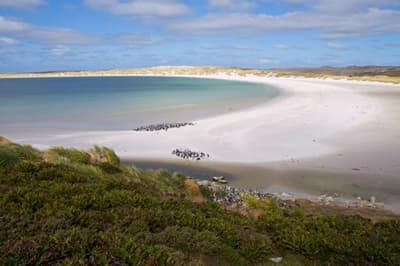
War was supposed to make this stretch of the Falklands deadly to anything that stepped in the wrong place. Instead, it made it strangely safe.
After the 1982 Falklands conflict, beaches and headlands around the islands were left seeded with thousands of landmines, laid largely by Argentine forces as defenses against British troops.[1] For humans, that meant warning signs, barbed wire, exclusion zones, and decades of staying away. For Magellanic penguins, it meant something else entirely. They were too light to detonate the mines. So while people kept out, the penguins moved in.[1]
And that is how a weapon of war accidentally became a wildlife sanctuary.
The Beach Humans Could Not Have
There is something almost absurd about the setup. A minefield is meant to control movement through fear. It draws an invisible line and says: do not cross. In the Falklands, that line held for decades. White-sand beaches that might otherwise have drawn walkers, vehicles, soldiers, surveyors, or developers became places humans approached only from a distance.[1]
The penguins, meanwhile, ignored the warning.
Magellanic penguins are small burrowing birds, nesting in the ground and moving in dense, noisy colonies. On beaches like Yorke Bay, near Stanley, they waddled through fenced-off areas and burrowed into dunes above sands humans were told not to touch.[1] The mines remained beneath them, lethal to people but functionally irrelevant to birds that simply did not weigh enough to trigger the pressure mechanisms.
This is the part that makes the story feel almost too neat. Human beings created a deadly perimeter. Human beings then respected it. Penguins, being penguins, did not care. The result was one of those rare ecological bargains produced not by wisdom, but by catastrophe.
Why The Penguins Were Safe
The sanctuary effect depended on a grim technical detail. Anti-personnel mines are designed to explode under a certain amount of pressure, enough to detect a boot, not a small seabird.[1] A Magellanic penguin, even stomping around in large numbers, simply does not deliver the weight the device is waiting for.
That did not make the landscape harmless. It made it selectively dangerous.
To a human, the minefield remained a map of possible mutilation. To a penguin, it was mostly just terrain. So the same patch of ground could be, at once, a military hazard and an ecological refuge, depending on how heavy you were and what kind of feet you had.
There is a larger lesson buried in that contrast. Nature does not obey the categories humans build for it. A minefield is a human idea. A penguin colony is a biological one. When the two collided in the Falklands, the birds exploited the gap.
An Accidental Reserve
Over time, the exclusion zones began to function like de facto protected areas. Minefields keep out more than soldiers. They keep out tourists, dogs, traffic, construction, and casual disturbance. In many parts of the world, conservationists have noticed the same bleak pattern: heavily militarized or contaminated zones can become strange havens for wildlife precisely because people stop entering them.
The Falklands offered a particularly vivid version of that paradox. Here were beaches of obvious beauty, barred to human access by old explosives, yet busy with thriving colonies of birds that had stumbled into a kind of protection no environmental planner would ever have designed.[1]
Magellanic penguins were not the only wildlife on the islands, of course, but they became the emblem of the absurdity. They looked almost comic moving across a deadly landscape, honking, nesting, and raising chicks where humans had to tread with extreme caution or not at all.[1]
The Problem With Calling It A Happy Ending
It is tempting to turn this into a tidy fable. Humans wage war. Nature adapts. Penguins win. But that version is too clean.
The mines were not benign just because penguins happened to evade them. They still scarred the landscape by making parts of it unusable to people for decades. They still had to be marked, monitored, and feared. And the fact that wildlife benefited from human absence does not transform explosives into conservation tools. It only reveals how disruptive human presence can be, and how quickly some species exploit the space we leave behind.
That is what gives the story its moral unease. The sanctuary was real, but it was born from something monstrous. A beach became safer for penguins because it had become too dangerous for everyone else.
The Demining Dilemma
Eventually, the same fact that had protected the penguins complicated the cleanup. The Falklands could not simply leave mines in the ground forever. Demining was slow, expensive, technical, and dangerous, and it had to be done with extraordinary care in places that had become ecologically sensitive over the years.[1]
That created a remarkable tension. The world generally agrees that landmines should be removed. But here was a case where removing them also meant reintroducing people, machinery, noise, and disturbance into landscapes that wildlife had come to occupy in relative peace.
So the question was not whether mines were good. They were not. The question was whether humans could undo one kind of damage without causing another.
That is a more modern problem than it first appears. We are used to imagining conservation as something deliberate, the result of planning, regulation, and enlightened policy. But sometimes conservation happens by accident, in the cracks left by history. And when those cracks close, we are forced to decide what exactly we are trying to restore: the land as it was before war, or the ecosystem that war inadvertently created.
The Strange Logic Of Human Absence
In the end, the Falklands penguin story is not really about mines. It is about absence.
Take humans away from a desirable piece of coastline for long enough and something else will often flourish there. Not always. Not perfectly. But often enough to be unsettling. The minefield worked as a sanctuary not because it offered care, but because it imposed distance. It did the one thing human beings are usually bad at doing voluntarily. It kept us out.
That is why the image lingers. A fence. A warning sign. Beyond it, burrows in the dunes and thousands of penguins going about their business as if geopolitics had never happened. The birds did not understand the war. They did not need to. They only needed a place where nothing large and noisy would trample their nesting grounds.
And for decades, thanks to a hidden ring of explosives laid by men who intended something very different, they had one.
Why This Feels So Unforgettable
Some facts stick because they are funny. Others because they are tragic. This one sticks because it is both at once.
An abandoned minefield becoming a penguin sanctuary sounds like satire until you realize it is a precise description of reality.[1] It compresses the twentieth century into one image: military technology, territorial conflict, ecological adaptation, and a colony of birds that accidentally found safety inside a human danger zone.
It also contains a quiet rebuke. We like to imagine that protecting nature requires dramatic intervention. Sometimes it does. But sometimes what nature needs most is the thing the minefield provided, by accident and at terrible cost: less of us.