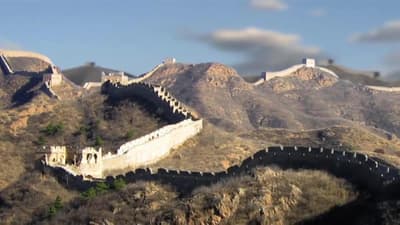
You can see the logic immediately. If a civilization is worried about raiders from the north, it builds a wall. And not just any wall, but a colossal one, a barrier so long it snakes across mountains, ridgelines, deserts, and grasslands for more than 20,000 kilometers.[1] The idea feels almost self-evident. Build something big enough, high enough, old enough, and surely it will keep danger out.
Except that is not what happened.
The Great Wall of China became one of the most famous defensive structures in history, and one of the least effective at doing the one thing walls are supposed to do. Invaders did not stop arriving because the wall existed. They came through, around, over, or with the help of the people guarding it. And that is the part of the story that makes the wall so interesting. The Great Wall was never merely a wall. It was an argument about control, geography, labor, fear, and the eternal hope that infrastructure can solve political problems.[1]
The Wall Was Never Just One Wall
Part of the confusion begins with the name. “The Great Wall” sounds singular, as though one emperor woke up, drew a line across a map, and ordered it built in one heroic burst. But the structure we call the Great Wall was assembled over centuries by different states and dynasties, using different materials, for different immediate threats.[1]
Some early walls existed even before China was unified. Then came Qin Shi Huang, the first emperor, in the third century B.C., who is often credited with conceiving the wall on an imperial scale after unifying China. What he actually did was more revealing. He linked and expanded earlier fortifications to create a broader northern defense system.[1] From the beginning, then, the Great Wall was less a single masterpiece than a long-running construction project driven by anxiety.
That anxiety was not imaginary. Northern nomadic groups posed a real military problem. They moved quickly, knew the terrain, and did not fight according to the neat territorial logic of settled empires. A fixed barrier may have looked like the perfect answer. But fixed barriers have a weakness so obvious that empires keep forgetting it: they stay fixed while enemies adapt.
The Ming Built the Version Everyone Remembers
The most famous sections of the Great Wall, the dramatic stone and brick stretches tourists know today, date mostly not to Qin Shi Huang but to the Ming dynasty, especially from the 14th through 17th centuries.[1] This matters because it means the image burned into the global imagination is not the wall’s beginning but its late, highly developed form.
By then, the wall had become an enormous system of fortifications, watchtowers, and signal stations. It was not simply masonry laid across a ridgeline. It was surveillance, communication, troop movement, and imperial presence translated into architecture. Fire and smoke signals could carry warnings. Garrisons could be stationed. Mountain passes could be controlled. In theory, this was defense made visible.[1]
In practice, theory kept colliding with people.
Why It Failed at the One Job It Had
The simplest version of the Great Wall myth is that it failed because walls are useless. That is too crude. Walls can slow movement, channel armies, raise costs, and buy time. The Great Wall did all of that at various moments. But slowing invaders is not the same as stopping them. And the title’s claim is right: it never effectively prevented invaders from entering China.[1]
Why not? Because a wall is only as strong as the political system behind it. You can build battlements across mountains, but you still need loyal commanders, supplied troops, intact communications, and a state capable of holding the line. If guards are bribed, if commanders defect, if a gate is opened, then the most impressive wall in the world becomes something like scenery.
That is the deeper lesson. The central weakness of the Great Wall was never just structural. It was human. A wall can resist ladders. It cannot resist betrayal.
And even when no one is betraying anyone, a frontier this long is a nightmare to secure. More than 20,000 kilometers is not a barrier so much as a logistical problem.[1] Every tower needs men. Men need food. Food needs roads. Roads need protection. Messages need to move quickly. Repairs need labor. Winter arrives. Deserts shift. Mountains isolate. Suddenly the wall is not one object. It is thousands of small management crises stretched across northern China.
The Real Function of the Wall
This is where the story turns. If the Great Wall did not reliably keep invaders out, why does it loom so large in history?
Because its most lasting importance was symbolic as much as military. Over time, it came to represent the strength, endurance, and self-conception of Chinese civilization.[1] That is not a consolation prize. Symbols matter, especially imperial symbols. The wall marked a boundary between the ordered world of the dynasty and the uncertainty beyond it. It said: here is the realm, here is the center, here is where civilization stands its ground.
That symbolic force may help explain why the wall outlived its own practical disappointments. Empires love visible certainty. A wall offers that. It turns fear into stone. It gives the state something to point to. Look, it says, we have drawn the line. Never mind that history keeps stepping over it.
A Monument to an Eternal Mistake
There is something almost modern about the Great Wall’s story. Again and again, governments confront messy human problems, mobility, shifting alliances, trade, raids, corruption, and they dream of a giant physical solution. Build the thing. Extend the barrier. Fortify the edge. Surely the structure will do what politics cannot.
But the Great Wall suggests the opposite. Physical defenses can matter. They can delay, organize, intimidate, and signal resolve. What they cannot do is eliminate the political and social complexity that produced the threat in the first place.
That is why the Great Wall remains so compelling. It is not merely a triumph of engineering, though it certainly was one. It is also a monument to an eternal mistake: confusing a line on the landscape with control over history.
And yet the wall endures, not as proof that the strategy worked, but as proof that the ambition was enormous. Dynasties rose, feared, built, rebuilt, and imagined they could secure a civilization with earth, brick, and stone. They could not. Invaders still entered China.[1] But in trying to prevent that, they created one of the most powerful symbols any civilization has ever left behind.