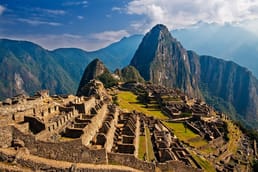
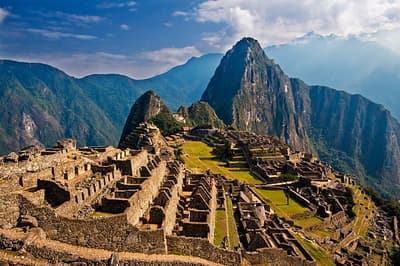
Machu Picchu feels ancient in the way mountains feel ancient. It sits on a ridge high in the Peruvian Andes, wrapped in cloud, built from fitted stone so precise it can look less like architecture than geology with intention. People see the photographs and assume the usual thing: this must be unimaginably old.
It is not.
Machu Picchu was built in the 15th century, most likely during the reign of the Inca ruler Pachacuti, which makes it roughly 550 years old.[1] That is old, certainly. But “ancient” in the loose, everyday sense often means something much deeper, something half-buried in prehistory. Machu Picchu is nowhere near that old. The Tower of London, by comparison, dates to the 11th century and is nearly four centuries older.[1] One of the world’s most iconic “ancient cities” is younger than a Norman fortress.
The Problem With the Word “Ancient”
This is partly a story about language. “Ancient” is one of those words people use less as a date and more as a mood. It means weathered, mysterious, monumental, difficult to place inside ordinary historical time. Machu Picchu has all of that. It is perched 2,430 meters above sea level on a mountain ridge in southern Peru, above the Sacred Valley, with the Urubamba River winding below through a steep canyon.[1] It looks like the sort of place that should have been old when Rome was young.
But it was built in the 1400s.[1] That puts it closer to the age of the printing press than to the pyramids, and closer to late medieval and early Renaissance Europe than to the Bronze Age. If you want to unsettle your own historical instincts, that is the fact to hold onto. Machu Picchu is not a relic from the dawn of civilization. It is a masterpiece from a comparatively recent empire.
That does not make it less impressive. If anything, it makes it more so. Once you stop imagining it as primordial, you start seeing it for what it really was: a highly sophisticated imperial project, deliberately built in a dramatic landscape by a state at the height of its power.
An Estate in the Clouds
Most archaeologists believe Machu Picchu was constructed as an estate for the Inca emperor Pachacuti in the 15th century.[1] This was not a random settlement that slowly accumulated over centuries. It appears to have been planned, designed, and built within the context of imperial ambition. It had terraces, temples, ceremonial spaces, finely cut stone buildings, water channels, and a layout that responded with extraordinary intelligence to the contours of the mountain.[1]
This is one reason the site keeps wrong-footing modern people. It does not fit the crude fantasy many still carry around about pre-Columbian civilizations. Machu Picchu was engineered. Its stones were shaped to fit together with remarkable precision. Its agricultural terraces stabilized the slopes and helped manage water and food production.[1] Its position was strategic, aesthetic, and symbolic all at once.
That is what the Inca state was capable of in the 1400s. Not ancient in the sense of dim and primitive, but recent enough to embarrass any easy timeline in which European modernity supposedly stood alone.
Why It Feels Older Than It Is
Machu Picchu feels older than the Tower of London because stone in mist has a different psychological effect than stone in a city. The Tower sits in London, amid buses, finance, glass towers, tourists buying snacks, and the general noise of a place that has never stopped being occupied. Machu Picchu sits in the Andes, detached from the everyday machinery of modern life. Isolation ages things in the imagination.
So does interruption. Machu Picchu was abandoned in the 16th century, likely around the time of the Spanish conquest, although the Spaniards themselves do not appear to have known the site in the way later generations would.[1] It then passed out of wider global awareness until the early 20th century, when Hiram Bingham brought international attention to it in 1911.[1] That gap matters. A building in continuous use feels historical. A site lost and rediscovered feels ancient, whether or not the math supports the feeling.
In other words, Machu Picchu benefits from the romance of disappearance. It was not simply old. It was hidden. And hidden things gather myth faster than visible ones do.
The Inca Were Not “Ancient” in the Way People Mean
There is another reason this misconception persists. Many people mentally compress all Indigenous American civilizations into one vague category of deep antiquity. That flattens enormous differences in time. The Inca Empire itself was relatively recent, flourishing in the 15th and early 16th centuries before the Spanish conquest.[1] Machu Picchu belongs to that moment.
That matters because it restores history to people too often pushed into myth. If you call everything “ancient,” you can accidentally make it seem timeless, and if it seems timeless, it stops feeling political, dynamic, and human. Machu Picchu was built by a real state, under a real ruler, for purposes legible inside a living empire. It was not the mysterious work of some vanished race outside time. It was Inca.
And the Inca, like everyone else, lived in history. They governed, built, expanded, worshipped, engineered, and ruled. Their accomplishments do not need false antiquity to be astonishing.
A Younger Wonder
If anything, the fact that Machu Picchu is “only” about 550 years old should sharpen your sense of wonder rather than diminish it.[1] This was a site constructed in terrain so difficult that its very existence still feels improbable. It was built without modern machinery, in a seismically active region, at high elevation, with architecture and infrastructure strong enough to survive centuries of weather, abandonment, and global fascination.
And because it is younger than people assume, it forces an uncomfortable correction. Many people have been trained, often without realizing it, to imagine technological and architectural sophistication as something that belonged naturally to Europe by the late medieval period, and only vaguely or primitively elsewhere. Machu Picchu quietly ruins that story.
While castles were standing in England, the Inca were building a royal estate in the clouds.
What the Comparison Really Reveals
To say that the Tower of London predates Machu Picchu by nearly 400 years is not to diminish Machu Picchu. It is to expose how badly many of us misread the past. We mistake atmosphere for chronology. We think remote means primordial. We think non-European means older, hazier, less dateable. Then a fact like this cuts through the fog.
Machu Picchu is not ancient because it comes from the dawn of civilization. It is “ancient” because it still has the power to make modern people feel small. That is a different kind of age altogether, measured less in years than in the durability of awe.
And perhaps that is the more interesting truth. The site does not need thousands of extra imaginary years to be extraordinary. It only needs its mountain, its stone, its silence, and the reminder that one of the world’s most mythologized lost cities was built in the same broad era that, elsewhere, produced cathedrals, cannons, and the early modern world.[1]