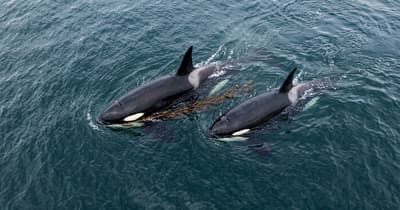
A drone over the Salish Sea caught a small household problem inside a very large animal. Two southern resident killer whales slid side by side near the surface, close enough that a short piece of bull kelp stayed pinned between their bodies. They did not simply brush past seaweed. One had bitten off a length of stalk, set it against another whale, and the pair rolled it between them like a floating back scratcher.[1]
Wild orcas have been filmed making seaweed grooming tools: they bite off bull kelp, hold it between two bodies, and rub together for minutes at a time. Researchers call the behavior allokelping.
In the footage described by the University of Exeter and the Center for Whale Research, whales of different ages used the kelp in pairs. The stalk mattered. Bull kelp is firm, slippery, and flexible, the sort of natural object that can stay useful while two animals move through water. Michael Weiss, the Center for Whale Research director who led the study, compared it to a filled garden hose and said the team was amazed when it first noticed the behavior.[1]
The Current Biology paper gives the careful scientific name: manufacture and use of allogrooming tools by wild killer whales. The act beneath that wording is wonderfully plain. A whale selects an object, trims it, places it, then needs another whale to cooperate. The tool only works if the second body stays close enough to keep the kelp from drifting away.[2]
Southern resident killer whales are already watched with unusual intimacy because the whole community is small. The Center for Whale Research listed 74 southern residents in July 2025, divided among J, K, and L pods.[3] In such a population, every calf, scar, and family movement can become part of a long record. The drone footage added something more private than a census: a habit of touch.
Phys.org's summary of the peer reviewed study notes that whales of all ages were seen doing it, and that the behavior appeared widespread in the population.[4] Researchers think allokelping may help skin health, social bonding, or both. The kelp has to be shared. One clever whale cannot make the tool work alone. It is a small ritual made from a plant that drifts through the same water the whales do.
After the stalk slips away, the ocean would look ordinary again: black backs, pale saddle patches, green water, a loose ribbon of kelp. The gesture still feels familiar. A creature with no hands made a grooming tool that required company. For a few minutes, the invention was not a spear, hook, hammer, or trap. It was a way for one whale to say, stay close, this feels better if we do it together.
Sources
- University of Exeter News, "Killer whales make seaweed tools to scratch each other's backs"
- Weiss et al., Current Biology, "Manufacture and use of allogrooming tools by wild killer whales"
- Center for Whale Research, southern resident orca population
- Phys.org, "Killer whales make seaweed tools to scratch each other's backs"