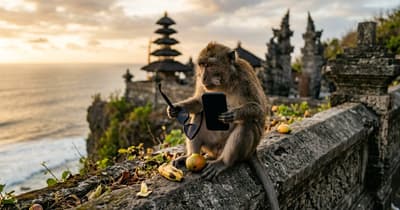
At Uluwatu Temple, the tourist who ignores the warning does not usually lose a banana. The expensive mistake is often a phone, a wallet, or the pair of glasses needed to see the cliff path back out. A macaque snatches the object, climbs just far enough away to make grabbing useless, and waits while a person learns what their belongings are worth in fruit.
At Bali's Uluwatu Temple, long-tailed macaques have learned to steal high-value tourist items such as phones, wallets, and glasses, then give them back only after humans offer food.
Researchers watched the trade in the open air, not in a laboratory puzzle box. Around the temple, free-ranging long-tailed macaques routinely took inedible objects from humans, kept possession of them, and released or handed them off after accepting food.[2] A 2017 study recorded 201 robbing and bartering events among four neighboring macaque groups during four months at Uluwatu.[4]
The better thieves seemed to understand the tourist's face before the tourist understood the monkey. Guardian reporting on the 2021 Royal Society study described macaques favoring electronics, wallets, and prescription glasses over lower-value objects such as hairpins or empty camera bags.[1] In the study's terms, the monkeys treated stolen objects like tokens, then held out for better quantity or quality of food when the token mattered more to the human.[2]
One negotiation lasted 25 minutes before the item came back, including 17 minutes of bargaining.[1] That is a long time to stand in a sacred tourist site while an animal calculates how badly you need your glasses. Temple staff often become the brokers, offering food and turning a theft into a transaction. The macaque does not need the phone. It needs the human to need the phone.
The habit also has an apprenticeship. The Royal Society paper found age differences in success, which pointed to experiential learning, and described the practice as population-specific, cross-generational, learned, and socially influenced.[2] Leca told the Guardian the behavior had been maintained in this population for at least 30 years.[1] A later Scientific Reports paper watched 13 subadult males for 197 observation hours and counted 44 successful food exchanges from 92 robberies after 176 attempts.[3] Even among monkeys, some were better operators than others.
The Uluwatu trick works because tourists bring a private price list into public. Phone over hat. Wallet over hairpin. Prescription glasses over almost everything. The monkeys do not read price tags. They read urgency. A tourist lunges, a staff member offers food, a valuable object becomes a bargaining chip, and the lesson is available to every young macaque watching from the wall.
At the temple gate, the safest visitor checks the zipper before checking the view. A monkey on the stone does not need the brand name on the phone, or the numbers in the wallet, or the prescription in the lenses. It only needs the first panicked reach for the strap.
Sources: