The expedition was supposed to be leaving South Dakota when the truck made one last demand. A flat tire kept the crew from pulling away, so the others went into town for the repair while Sue Hendrickson walked off to look at a bluff the group had not searched closely. She noticed a few large bones weathering out of the rock.[1]
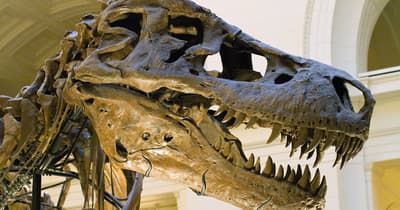
That delay led Hendrickson to the fossil now called SUE: the largest and most complete Tyrannosaurus rex skeleton yet found, a dinosaur so intact that a roadside inconvenience became a museum changing discovery.
On August 12, 1990, the bones in the bluff did not look like a museum centerpiece yet. The Field Museum says Hendrickson had spotted vertebrae jutting from an eroded South Dakota hillside, north of Faith, during a commercial excavation trip.[2] The crew returned to the spot, and what first showed as a few exposed pieces became a skeleton that took six people 17 days to remove from the ground.[2]
SUE later measured more than 40 feet long and 13 feet tall at the hip, with about 90 percent of the skeleton present by bone volume.[2] Most dinosaurs arrive as riddles: a jaw here, a leg bone there, enough for a scientist to infer an animal and enough missing to keep the animal partly out of reach. SUE arrived with rare pieces, including a furcula, an ear bone, and almost all of the gastralia, the belly ribs that helped reshape what researchers thought a T. rex body looked like.[3]
By 1997, the fossil Hendrickson found had acquired lawyers, bidders, donors, and a price tag. The Field Museum describes a five year custody battle that ended in a public auction, where the museum, backed by McDonald's, Walt Disney World, and private donors, bought the skeleton for $8.4 million.[2] A dinosaur found because a truck could not leave became the most expensive fossil ever sold at auction at the time.[2]
Twelve museum preparators then spent more than 30,000 hours cleaning and preparing the bones, with another 20,000 hours spent on research and planning for the exhibit.[2] Later work changed the mount again: added gastralia widened the rib cage, the wishbone and shoulder blades were corrected, and SUE's posture shifted toward the animal scientists thought had once moved through the Cretaceous world.[4]
On SUE's left jaw, researchers found holes that looked at first like bite marks. Field Museum notes now treat them as pathology, perhaps from infection or a parasite.[3] The famous skeleton was not pristine. It was scarred, altered, and useful precisely because so much of the battered body remained.
The flat tire never made it into the display case. No visitor stands in the museum studying rubber, lug nuts, or the road out of Faith. Still, the whole story keeps circling back to that small mechanical pause: a truck waiting for repair, a woman choosing to walk, and a few bones showing through a bluff before the crew finally left.
Sources