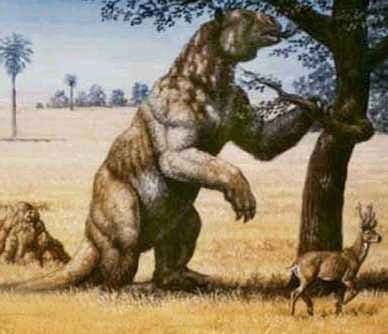
On a remote salt flat at White Sands, a human foot once landed inside the footprint of a giant ground sloth. The sloth’s track was not a neat little animal print. It belonged to a creature seven to eight feet tall, powerfully built, with forelimbs tipped by claws compared by researchers to a wolverine’s.[1]
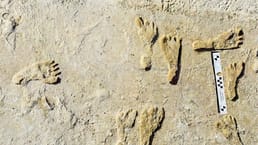
At White Sands in New Mexico, fossil trackways preserve giant ground sloth footprints alongside human footprints, including places where people stepped directly inside the sloth tracks. Researchers interpret some of these 10,000 to 15,000-year-old marks as evidence of humans stalking, distracting, and possibly hunting the animal.
The prints lie in gypsum-rich ground on the dried bed of ancient Lake Otero, in what is now White Sands National Park.[2] The basin is desert now, famous for white dunes and hard glare. During the Ice Age, it held water, grasslands, and vegetation that drew mammoths, ancient camels, Harlan’s ground sloths, dire wolves, and American lions.[2]
The 2018 trackway was not one dramatic footprint. Scientists described more than 100 prints, dating to roughly 10,000 to 15,000 years ago, preserved among particles of gypsum.[3] In several places, the human footprints appear inside the larger sloth impressions, as if someone had stepped into the animal’s path on purpose.[1]
The footprints inside the footprints
David Bustos, a White Sands park naturalist, discovered the trackway years before the public announcement.[1] When Matthew Bennett of Bournemouth University and other researchers studied it, they saw a pattern that looked too deliberate to dismiss. The sloth’s stride was longer than a person’s, yet a human still seems to have followed close behind, placing feet into the much larger tracks.[3]
Near some of the human prints, the sloth appears to have changed direction suddenly.[3] Researchers identified circular track patterns they called “flailing circles,” places where the animal may have risen onto its hind legs and swung its forelegs in defense.[1] Bennett noted that a direct approach to such an animal would have carried serious risk; a hunter facing those claws at close range might not walk away unharmed.[1]
Other footprints widen the scene. The National Park Service reported human tracks at a safer distance, suggesting group behavior rather than a single person chasing an animal across the flat.[1] Bennett proposed that some people may have distracted the sloth while another approached near the defensive circles, perhaps on tiptoe.[1] VOA’s account of the research also notes that one person appeared to get very close to a sloth on tiptoe.[3]
A hunt without a carcass
No spear point is lodged in bone. No butchered skeleton waits at the end of the trail. The evidence is thinner and stranger than that: pressure marks in old mud, hardened into a record of movement. The tracks suggest humans were following, crowding, or confronting a giant sloth, but the sources do not show that the hunt succeeded.[4]
That is why the White Sands prints feel so immediate. Bones can tell archaeologists what died. Footprints can show a few seconds when nobody knew the outcome yet. They preserve a turn, a close approach, a possible feint, and the space between a dangerous animal and the people around it.
White Sands continues to reveal these brief encounters. The park says it has the largest collection of fossilized human footprints, scattered across the old Lake Otero landscape.[2] In 2021, Archaeology Magazine described Acoma Pueblo sisters Bonnie Leno and Kim Charlie finding sloth and human tracks during fieldwork at the park. Leno recalled brushing sediment away from an adult human footprint; just inches away was the track of a giant sloth.[5]
The New Mexico trackway does not simply place humans and giant ground sloths in the same Ice Age ecosystem. It puts them in the same few feet of mud, one footfall inside another, a person’s toes pressed into the fading edge of a vanished animal’s step.
Sources
- National Park Service, “Ghost Fossils at Park Reveal Life and Death Story from the Ice Age”
- National Park Service, “Fossilized Footprints”
- VOA Learning English, “New Mexico Desert Captures Evidence of Sloth Hunt”
- Wikipedia, “White Sands footprints”
- Archaeology Magazine, “Ghost Tracks of White Sands”