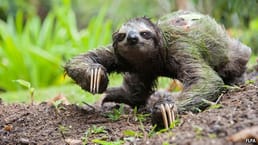

About once a week, a three-toed sloth leaves the safety of the canopy, climbs all the way down a tree, digs a small depression near the trunk with its tail, defecates, covers the latrine with leaves, and slowly climbs back up again.[1]
Evidence suggests three-toed sloths may be tending a tiny fur-based farm: algae grows in their cracked hair, moths help sustain that ecosystem, and the sloth may eat the algae as a lipid-rich supplement to its leaf-heavy diet.
On the ground, the animal pays dearly for that routine. Three-toed sloths live on leaves from only a few trees, a low-nutrient, toxin-laced diet tied to the slowest digestion rate recorded for any mammal and a metabolic rate less than half of what would be expected for their body mass.[1] A single bathroom descent can cost an estimated 8 percent of a sloth’s daily calories. It also puts the animal where it is most vulnerable, since more than half of documented sloth mortalities occur when sloths are near the forest floor.[1]
Two-toed sloths usually do things differently. They have larger home ranges, eat a broader diet that can include fruit, leaves, insects, small lizards, and carrion, and often defecate from the canopy more than once a week.[1] The three-toed sloth’s careful descent, tail-dug hole, leaf covering, and return climb have therefore become one of the odder bathroom mysteries in mammal behavior.
The Animal With a Garden in Its Coat
A sloth hair shaft is a small piece of habitat. Its grooves and microcracks create sheltered places for algae, fungi, moths, beetles, and other tiny organisms to live.[2] Under a microscope, three-fingered sloth hair can show green algae settled into those cracks, and researchers have found species of algae and fungi in sloth fur that have not been found anywhere else.[2]
In the canopy, that greenish coat can help a sloth disappear. The Sloth Conservation Foundation describes the fur community as part of the animal’s camouflage, tinting the coat toward the color of rainforest leaves.[2] Slow movement adds to the disguise. A sloth does not outrun a harpy eagle or a jaguar. It survives, much of the time, by being hard to notice.
Jonathan Pauli, a wildlife ecologist at the University of Wisconsin-Madison, has studied the community living in sloth fur and its connection to dung, moths, and algae.[3] In the proposed three-way mutualism, the sloth provides a living home, the moths use the sloth for shelter and transport, and the algae may give the sloth food.[3]
Why the Moths Need the Toilet Trip
The moths are pyralid moths in the genus Cryptoses. Pauli describes them as largely flightless moths that live in the fur of both two-toed and three-toed sloths.[3] Their young, however, do not grow up in fur. They grow up in dung.
When a sloth descends to defecate, adult female moths can leave the animal and lay eggs in the fresh feces. The larvae feed there, mature, and the new adult moths eventually make their way back into the canopy to colonize a sloth.[3] That gives the risky weekly descent a possible payoff: by pooping on the forest floor, the sloth may help maintain the moth population living in its coat.[1]
The moths, in turn, are thought to help sustain the fur ecosystem that supports algae growth.[3] The algae are more than a green stain. Research summarized by Pauli and others suggests sloths consume algae from their fur, and that the algae are rich in lipids, a useful supplement for an animal living on leaves.[3]
The proposed cycle is strange because each piece is so physical: a low-energy mammal, a dangerous weekly latrine, moth larvae feeding in dung, cracked hairs holding algae, and a coat that may both hide and feed its owner. The sloth climbs down, digs, deposits, covers the spot with leaves, and returns upward carrying a small green world in its fur.