In a University of Cincinnati geoscience lab, Associate Professor Joshua Miller bent over the jawbone of a prehistoric horse, a curved piece of bone from an animal whose living relatives now seem inseparable from ranch fences, rodeos, and the American West.[5] The oddity is that North America was not merely a place horses reached. It was the place they left, lost, and later entered again by ship.
Horses originated in North America, spread into Eurasia across ancient land bridges, disappeared from North America around 10,000 years ago, and returned after Spanish colonizers brought domestic horses back to the Americas in the late 1400s and early 1500s.
Long before saddles or cavalry, horse evolution unfolded over roughly 50 million years. Paleozoologists trace the line from a small, dog-sized forest animal called Eohippus toward the large, single-toed modern horse, with much of that history taking place in North America.[2] The horse family is unusually well documented in fossils, giving scientists one of the clearest evolutionary sequences known for any animal.[2]
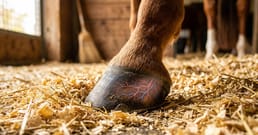
Those early animals would not have looked at home under a cowboy. Their ancestors had spread-out toes and lived in forested habitats.[2] As climates shifted and grasslands expanded, their bodies changed with the ground beneath them. Teeth became better suited for grinding abrasive grasses. Feet changed. A small browser of ancient forests gradually became an animal built for open country.[2]
The road out of America
The modern horse genus, Equus, originated in North America millions of years ago.[5] When sea levels fell, land opened between Alaska and Siberia at the Bering Strait, allowing horses to move between continents.[4] Recent ancient DNA work described by the University of Cincinnati found that this was not a single departure. Horse populations crossed back and forth between North America and Eurasia, with exchanges continuing as recently as the last glacial period, about 50,000 to 19,000 years ago.[5]
That escape route mattered. Horses survived in Eurasia after their North American relatives vanished near the end of the Pleistocene. Sources commonly place that disappearance around 10,000 years ago, or within a range of roughly 8,000 to 12,000 years ago.[1][2] For thousands of years afterward, the continent that had produced the horse had none.
Across the ocean, people changed the animal’s future. Domestic horses came from wild horse populations in Europe and Asia and were domesticated about 6,000 years ago.[4] By the time Europeans crossed the Atlantic, the horse was no longer only a grazer of steppe and grassland. It was transport, labor, warfare, status, and wealth on four legs.
The return by sea
In 1493, on Christopher Columbus’s second voyage to the Americas, Spanish horses were brought across the Atlantic to the Caribbean.[1] In 1519, Hernán Cortés reintroduced horses to the North American mainland.[1] The animal coming ashore with Spanish expeditions was domesticated and Eurasian by recent history, but its deeper lineage led back to North America.
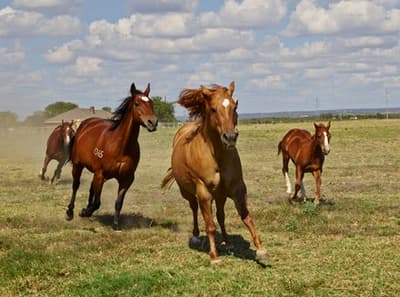
That circular history is one reason the modern mustang debate can become so charged. Wild horses in North America today descend from reintroduced Spanish horses, yet some researchers frame them biologically as reintroduced rather than simply invasive because horses had such a long evolutionary history on the continent.[4] The present scale is large too. In 2023, the United States had an estimated 6.65 million horses, and about 82,000 feral horses roamed freely in parts of the country, mostly in the West.[1]
A horse running in Texas, Nevada, or Wyoming is carrying a looped history in its bones. Its ancestors grew up on this continent, crossed to another, disappeared from their first home, and returned in the holds of Spanish ships. The hoofprint looks local. The journey inside it circles half the planet.
Sources
- Horses in the United States, Wikipedia
- Evolution of the horse, Wikipedia
- The Fascinating History of Horses in North America, Animals Around The Globe
- The Survival Journey of Horses: From North America to Global Existence, American Wild Horse Conservation
- Ancient horses crossed back and forth over land bridge, University of Cincinnati