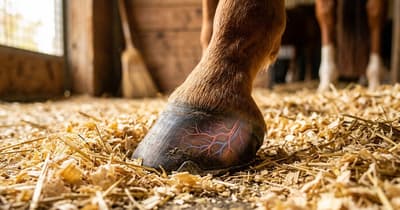
The farrier picks up the hoof and, for a moment, the whole horse changes shape. A thousand-pound animal folds one leg, leans into a practiced human shoulder, and waits. To anyone outside the barn, the underside of the foot can look like tough black equipment, closer to a boot sole than living tissue.
That is the mistake. A horse's hoof is not just something it stands on. It is part of how the animal keeps its blood moving.
The problem is gravity. Blood can get down to the foot easily enough, but it has to return from the ground back toward the chest. In the lower leg and hoof, horses do not have muscles that squeeze veins the way calf muscles help humans push blood upward when we walk.[1] So the hoof uses the thing it has in abundance: pressure.
When the hoof lands, the horse's weight compresses soft structures and networks of veins inside the foot. When the hoof lifts, those tissues relax. Extension Horses describes this as a hoof pumping mechanism, often nicknamed the hoof's role as a second heart.[1] It is not a second heart in the cartoon sense. It does not beat on its own. It borrows the rhythm of walking.
That rhythm is written into the anatomy. In a Journal of Anatomy study, researchers examined 46 pairs of healthy horse hooves and mapped the veins of the hoof wall. They found organized venous plexuses and drainage patterns, then argued that weight bearing helps return venous blood from the digit.[2] In plain barn English, the foot is built so that standing, stepping, loading, and unloading all matter.
This is where a small anatomical fact turns into a whole horse culture. People who live around horses repeat the old line: no hoof, no horse. It sounds like stable wisdom because it is. Oregon State Extension's anatomy guide treats the hoof and lower leg as central to soundness, the everyday word horse people use for a body that can move well.[3] Merck Veterinary Manual defines lameness as an abnormal stance or gait, often tied to pain or dysfunction, and calls it the most common cause of loss of use in horses.[4]
So a crack in the hoof wall, a bad trim, or a persistent sore step is not a cosmetic problem at the edge of the animal. It threatens the whole arrangement. The hoof has to be support column, shock absorber, traction surface, sensory tool, and circulatory helper all at once.
Horses look powerful because we notice the obvious machinery: shoulder, neck, muscle, speed. The hidden bargain is lower down. The animal's grandeur depends on a foot that turns weight into return, ground into flow, and every ordinary step into a small act of keeping itself alive.