When Young-Hui Chang picked up a dead flamingo by one leg, the bird kept its standing posture. He and fellow researcher Lena Ting were investigating how flamingos spend so long perched on a single, slender leg, and here was a specimen maintaining the familiar pose without any active muscle force. Chang later said he could not explain what had prompted him to pick it up.[2]
For the study, published in 2017, Birmingham Zoo supplied two frozen adult Caribbean flamingos, which the researchers thawed before examining their joints. No birds were killed for the research. In the controlled tests, clamps held a specimen by the lower part of one leg while its body was tilted forward and backward. Its hip and knee largely retained their configuration through a wide range of angles.[1][2]
Keeping the foot beneath the body allowed the leg to bear the bird's weight without contracting muscles. Move the leg into a more vertical alignment, approximating a two-legged stance, and the joints became unstable. The support holding the leg was important: this was a test of how the body stayed upright above it, not a demonstration of a dead bird balancing freely on a tabletop.[1]
Beneath the feathers, a flamingo's thigh lies almost horizontally, with the knee and hip close to the body. The bend halfway down the long visible leg is actually its ankle. With the foot in the right place, gravity and the limits of joint movement help hold the upper leg in position. Chang likened the arrangement to a hammock or sling. The bird's weight helps engage the support that carries it.[1][2]
People watching flamingos had also wondered whether putting a leg away helped keep them warm. Matthew Anderson and Sarah Williams investigated that possibility in captive Caribbean flamingos, reporting in a 2010 study that one-legged resting became less common as temperatures rose. Birds in water used the posture more often than birds on land. Their observations supported a role in temperature regulation, leaving Chang and Ting with the practical question of how a bird could hold the position for so long.[3]
At Zoo Atlanta, getting live birds onto a measuring plate required some cooperation from the keepers. The adults handled changes to their surroundings poorly, so staff wanted the researchers to leave them alone. Juveniles could be handled, and keepers placed them near the force plate after feeding, hoping a full meal would help them settle down. The team collected measurements from eight young Chilean flamingos.[1][2]
From those recordings, Chang and Ting could measure sway, although they would still need direct muscle measurements to establish how much effort the living birds used. The cadavers had shown that passive support was possible; the young flamingos let them watch what happened as a bird relaxed. During one continuous twenty-minute recording, a flamingo standing on one leg closed its eyes, possibly falling asleep. Its measured sway diminished, and the point where it applied force remained within a small area beneath its foot.[1]
Sources
- Chang and Ting, Biology Letters (2017)
- Georgia Tech: Tech Study Stands Up for Flamingos' Unique Pose
- Anderson and Williams, Zoo Biology (2010)
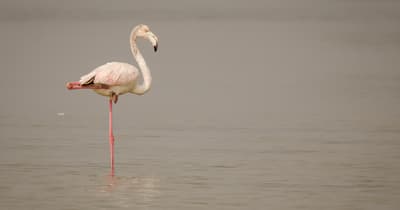
Illustrative photo: a living greater flamingo at Pulicat Lake, India, not a bird from the experiment. Photo by Deepak Sundar, via Wikimedia Commons, CC BY-SA 4.0. Cropped and resized; this image adaptation is shared under the same license.