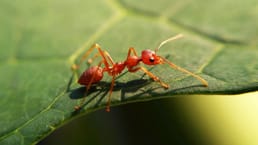
Robert Wagner left a colony of fire ants floating in a laboratory tank overnight. The setup was supposed to keep them from drifting to the glass walls: water below them, a vertical rod in the middle, the ants clinging to one another like a living pancake. By morning, the tank on his table was empty.[1]
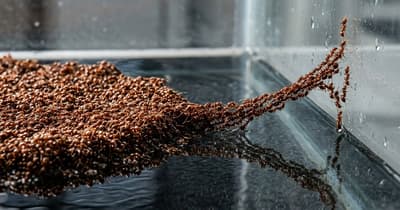
Fire ant colonies can survive floods by locking their bodies into floating rafts. In experiments, those rafts sometimes grow long, tentacle-like arms, and one colony used an arm to reach the tank wall and escape.
On the recording, the raft pushed one protrusion past the camera frame, apparently far enough to find the side of the tank. Then the orange-brown mass seeped along its own living bridge and disappeared.[1]
Wagner and his colleagues had put thousands of ants into water to study a behavior that looks less like marching and more like slow collective weather. Fire ants do not simply pile into a floating lump when floodwater rises. A lower layer grips together as a structure, while freer ants walk across the top, fall into the edge, and become new raft material.[2]
In the Royal Society paper, that circulation gets a wonderfully mechanical name: treadmilling. Ants in the raft's underside can crawl out and rejoin the active upper layer. Ants above are deposited along the edge. The colony contracts in one place and expands in another, which lets finger-like projections appear without a foreman ant assigning work.[2]
Earlier researchers had already shown why a fire ant flood raft is so hard to drown. The ants trap air between their bodies, and their legs and waxy surfaces help repel water.[3] Wagner's empty tank shifted attention from floating to searching.
Any ant bridge reaching away from the raft can be cut off, stranded, or lost. That risk makes sense only if the colony is using part of itself to test the room. In the Smithsonian account, outside researcher David Hu noted the danger of anything sticking out from a protective group, because a projection can be separated from the whole.[1]
During the escape, thousands of small movements made a temporary body that could feel across water. The colony tested space by spending parts of itself, then pulled the rest of the animal-made raft toward the answer.
In a quiet lab, the proof sat there as an absence: no neat diagram, no clean measurement, just a blank tank and a recording. Flood survival usually sounds like endurance: hold together, float, wait. The fire ants add a stranger verb. They reach, one living edge turning into a question.