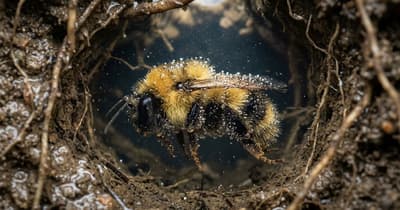
A bumblebee queen can spend the winter buried underground in a cavity about the size of a grape. If that tiny room floods, the obvious ending seems grim. But common eastern bumblebee queens can survive complete submersion for at least a week, and new research shows some can keep exchanging gases underwater for up to eight days.[1]
The trick is not one miracle adaptation. It is a stack of small survival moves. In lab experiments, researchers found low but steady carbon dioxide production while queens were submerged, paired with a decline in dissolved oxygen in the water. In plain English, the bees were still breathing, just barely, through underwater gas exchange.[1]
That discovery builds on a wonderfully accidental first clue. At the University of Guelph, refrigerated tubes holding overwintering queens unexpectedly filled with water. The researchers assumed the insects were dead. After the water was drained, the queens began to move again. A follow-up experiment tested 143 common eastern bumblebee queens and found that many survived seven days underwater, whether held beneath the surface or allowed to float.[2]
The reason this matters starts with the queen's lonely winter job. In most bumblebee species, the old colony dies before winter. Newly mated queens burrow into soil and enter diapause, a deep pause in development and metabolism that can last six to nine months. When spring arrives, each surviving queen has to start a new colony from scratch.[3]
Flooding is exactly the sort of threat a sleeping insect cannot dodge. Heavy rain, snowmelt, and rising water tables can fill underground chambers while a queen is too sluggish to escape. The new study suggests the queens cope by combining underwater respiration with anaerobic metabolism and an even deeper metabolic slowdown. ScienceAlert reported that submerged diapausing queens cut carbon dioxide output from about 15.42 microliters per hour per gram before submersion to about 2.35 after eight days underwater.[4]
There is still a cost. The submerged bees accumulated lactate, a sign that their cells were also making energy without enough oxygen. After rescue, their metabolism rose during recovery as that chemical debt cleared.[1]
The unexpected angle is that this is not a fish-like superpower. It is more like emergency mode: breathe a little, burn energy differently, and need almost nothing until the water recedes. For a creature whose whole future colony depends on one overwintering body, that may be enough.
Bumblebees still face pesticides, habitat loss, disease, heat, and climate stress. A queen that can outlast a flooded burrow is not invincible. But she is tougher than she looks, and sometimes the first spring buzz begins with an insect waiting underwater in the dark.